Being able to see shouldn’t feel like a luxury subscription service. But between the surprise shipping fees, the endless bottles of solution, and the regular visits with your optometrist for a prescription update, the costs inevitably add up fast. For many Americans, contact lenses have become one of those invisible expenses we accept, a quiet drain on the monthly budget.
The sticker shock is getting worse, too. We’ve traded the hassle of cleaning for the ultimate convenience: daily disposables. It’s a trend that’s taking over, with Contact Lens Spectrum reporting they accounted for 44% of all new fittings in 2025. But as Reuters points out, that convenience carries a 30% to 50% premium over classic reusables.
We’re already hunting for the best gas prices and stacking coupon codes for our groceries. Your eyes deserve the same level of shop-savvy energy.
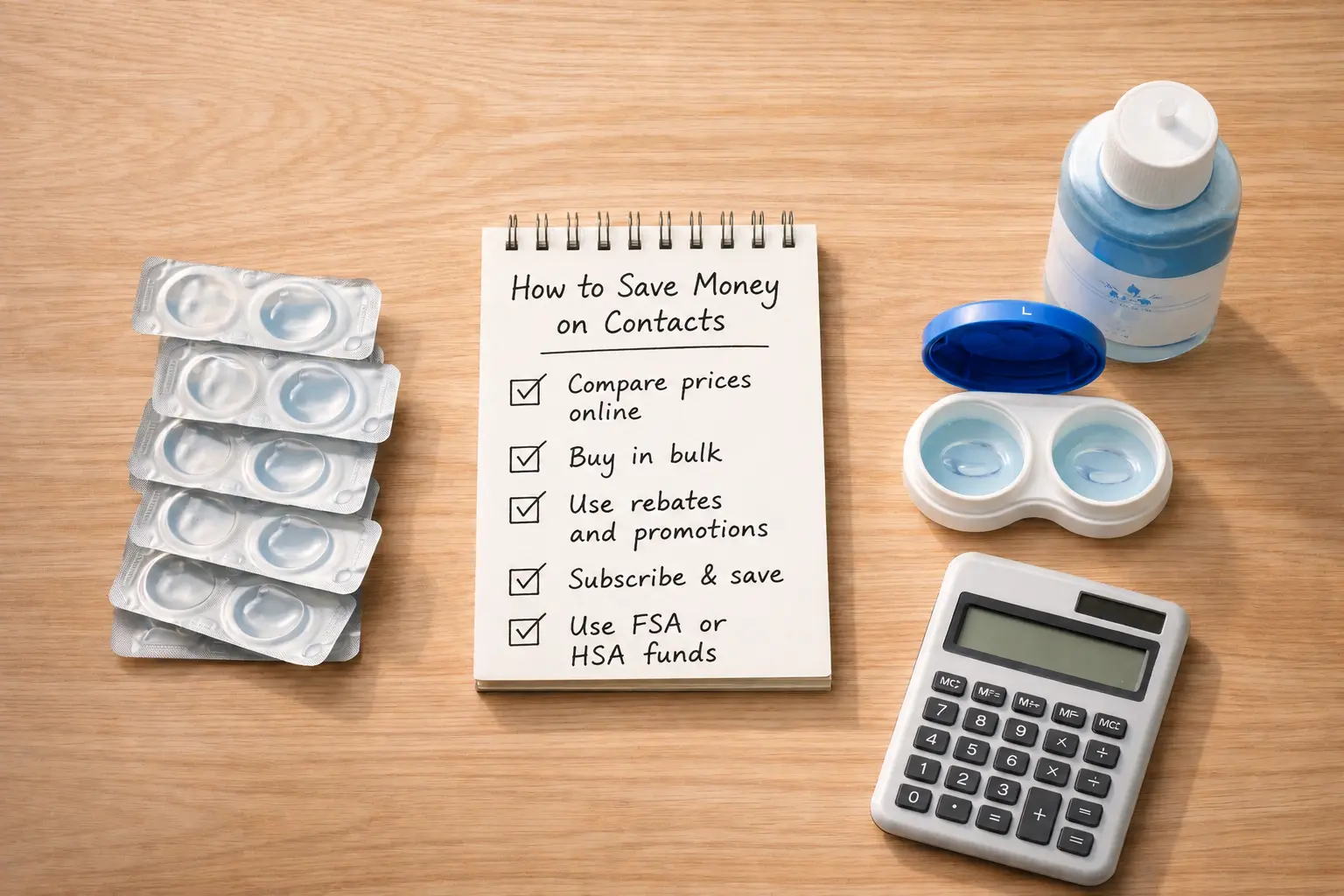
So, how to save money on contacts? You don’t have to settle for the MSRP. By comparing retailers, hunting down manufacturer rebates, and maximizing your FSA/HSA dollars, you can stack savings to keep your vision crystal clear and get the best cheap contacts without emptying your wallet.
Why Buying Contact Lenses Feel More Expensive Now
Feel like you’re paying more to see clearly this year? You’re not imagining it. The unpleasant surprise at the checkout screen isn’t just about the price of the plastic lenses.

The Concealed Ecosystem of Eye Care
When you buy contact lenses, you aren’t just paying for the product. You’re paying for the entire infrastructure required to wear them safely. For the average American, the real cost includes:
- Eye exams and specialized contact lens fittings
- Multi-purpose solutions and storage cases
- Sales tax and those pesky processing fees that only appear at the very last step of checkout.
- The background engine passed on to customers, including rates from shipping, logistics, and more
Inflation Hits the Medicine Cabinet
Your vision costs are riding the same upward wave as the rest of the U.S. healthcare market. According to the U.S. Bureau of Labor Statistics (BLS), as of March 2026, the eyeglasses and eye care category climbed 1.6% over the previous year.
While that sounds modest, the services surrounding your eyes are jumping even faster. Medical care services rose 3.7%, and professional services spiked 4.1%. Essentially, the person checking your eyes and the building they work in are becoming more expensive to access. Those costs are being passed directly to you.
The Shipping Trap
In the age of Amazon Prime, we’ve grown to hate paying for delivery. However, for contact lens wearers, shipping is becoming a major budget killer. The BLS reported that postage and delivery services surged 6.4% year-over-year in early 2026. That insane deal you found on a third-party site can evaporate instantly once you add shipping fees, small-order surcharges, or the cost of rushed delivery when you realize you’re down to your last pair.
The Contact Lens Rule and The Exam Cycle
In the U.S., your eyes are essentially under federal regulation. Under the FTC’s Contact Lens Rule, unless state law or specific medical needs dictate otherwise, your prescription is generally only valid for one year.
This creates a mandatory prescription cycle. Just as you find a good rhythm with your spending, your prescription expires, forcing you back into the doctor’s chair for another exam fee before you’re even allowed to hit Buy Now again. It’s a necessary safety measure, but it’s also a recurring financial hurdle.
Calculate Your True Annual Cost First
If you’re only looking at the price tag on a single box, you’re only seeing half the story. In the world of vision care, a $30 box can actually be more expensive than a $70 box.
Look Beyond the Cardboard
Let us tell you a secret. The box price is a marketing tactic. To get the actual price of your contact lens, you need to audit four things:
The Hidden Costs of Reusables
Daily disposables have the most honest pricing; you use a fresh pair, you throw them away. The math is simple. However, if you opt for monthlies or bi-weeklies because the box price looks lower, don’t forget the other expenses. When you add up the yearly cost of multi-purpose solutions, disinfecting cases, and cleaning supplies, that cheaper lens might suddenly cost as much as a premium daily.
Do the Final Checkout Math
Before you get attached to a brand, run a mock checkout all the way to the final screen. This is the only way to see the real cost from:
- Shipping and processing: When you buy contacts online, some sites lure you in with low prices but hit you with a $20 handling fee at the end.
- Rebates: Many American retailers offer massive “Buy a Year’s Supply” rebates. A $100 rebate can flip the script on which brand is the best value.
- The tax-and-tool stack: Factor in your FSA/HSA funds and vision insurance. Using pre-tax dollars effectively gives you an automatic ~20 to 30% discount, depending on your tax bracket.
Pro Tip: Never judge a lens by its product page. When you order contacts, add up the boxes, the supplies, and the fees, then subtract your rebates and tax savings. That final number is the only one that matters.
The Smart Saver’s Playbook For Buying Contact Lenses
Saving money when you buy your contacts is mostly about stacking. A smart saver doesn’t just look for a low price. They layer discounts like a pro. Flip this book for tips on how to save money on contacts.
If the Price Looks Too Good to Be True, It Probably Is
Everybody loves a bargain. However, there’s a difference between saving money and taking a gamble. In the U.S., contact lenses are classified as Class II or Class III medical devices. These aren’t just pieces of plastic; they are precision-engineered tools that sit directly on your cornea. Saving $20 isn’t worth risking a corneal ulcer or a trip to the ER.
So, how do you spot a deal that is actually an eye health hazard?
No Prescription
This is the biggest warning sign in the industry. Under federal law, any legitimate U.S. retailer must verify your prescription with your eye doctor or see a copy of your script before they can ship.
If a site tells you that you don’t need a prescription, they are breaking the law. These sellers often bypass safety regulations. You could end up with counterfeit lenses or dangerous products.
Franken-Lenses
Your prescription isn't just about your vision strength. It also includes the base curve and diameter. These are specific measurements of how that lens fits the unique shape of your eye.
Sketchy sites might offer a generic equivalent or a look-alike brand that’s cheaper.
A lens that’s slightly too tight can starve your eye of oxygen, while one that’s too loose can cause microscopic scratches on your cornea. Stick to the exact brand and model your doctor fitted you for.
Check the "Best By" Date
Sometimes, enticing massive discounts are offered because a retailer is trying to offload short-dated or nearly expired stock.
When your boxes arrive, check the expiration dates immediately. If you bought a year’s supply and the boxes expire in three months, you haven't saved money; you’ve wasted it.
Never buy from a seller that ships opened, damaged, or unsealed boxes. If the sterile seal is compromised, those lenses belong in the trash, not in your eyes.
Save Smartly
The goal of smart shopping is to get the premium product for a discounted price. Don’t settle for a budget product that compromises your health. The safest way to save is to use our smart saver’s playbook about stacking mentioned earlier with a verified, prescription-checking retailer.
Frequently Asked Questions About Saving Money On Contacts
-
Some retailers accept unopened, unmarked, and unexpired boxes for return or exchange. Note that policies vary. Check the return policy before buying a large supply, especially if your prescription has changed recently or your eye doctor is still adjusting your fit.
-
It can be cheaper if you wear daily contacts, since every glasses day means one less pair used. For monthly or bi-weekly lenses, the savings depend on the replacement schedule because the lens timeline usually starts once the package is opened.
-
Yes, toric and multifocal contact lenses usually cost more than standard spherical lenses because they have more specialized designs. If your prescription calls for these lenses, don’t switch to regular contacts just to save money. The wrong lens type can lead to blurry vision, poor fit, and wasted boxes.
-
Some online retailers and optical sellers give discounts to students, teachers, military members, seniors, or healthcare workers through verified discount programs. Before checkout, look for a discount page or promo field, then compare that savings against any rebate or coupon you already plan to use.
-
Store-label contact lenses can be safe only when your eye doctor prescribes or fits you for that exact product. Don’t swap lenses just because the packaging looks similar or the price is lower. Contact lenses have specific measurements, materials, and designs that need to match your eyes.
References
- International Contact Lens Prescribing In 2025. Contact Lens Spectrum. https://www.clspectrum.com/issues/2026/january-february/international-contact-lens-prescribing-in-2025/. Published January 1, 2026.
- Daily Disposable Contact Lenses Set To Power Market Rebound In 2026. Reuters. https://www.reuters.com/business/daily-disposable-contact-lenses-set-power-market-rebound-2026-2026-02-18/. Published February 18, 2026.
- About Contact Lenses. Centers for Disease Control and Prevention. https://www.cdc.gov/contact-lenses/about/index.html. Published May 27, 2025.
- About Publication 969, Health Savings Accounts and Other Tax-Favored Health Plans. Internal Revenue Service. https://www.irs.gov/forms-pubs/about-publication-969. Published March 30, 2026.
- Contact Lens Prescription. U.S. Food and Drug Administration. https://www.fda.gov/medical-devices/contact-lenses/contact-lens-prescription. Published October 28, 2020.
Related Articles
-
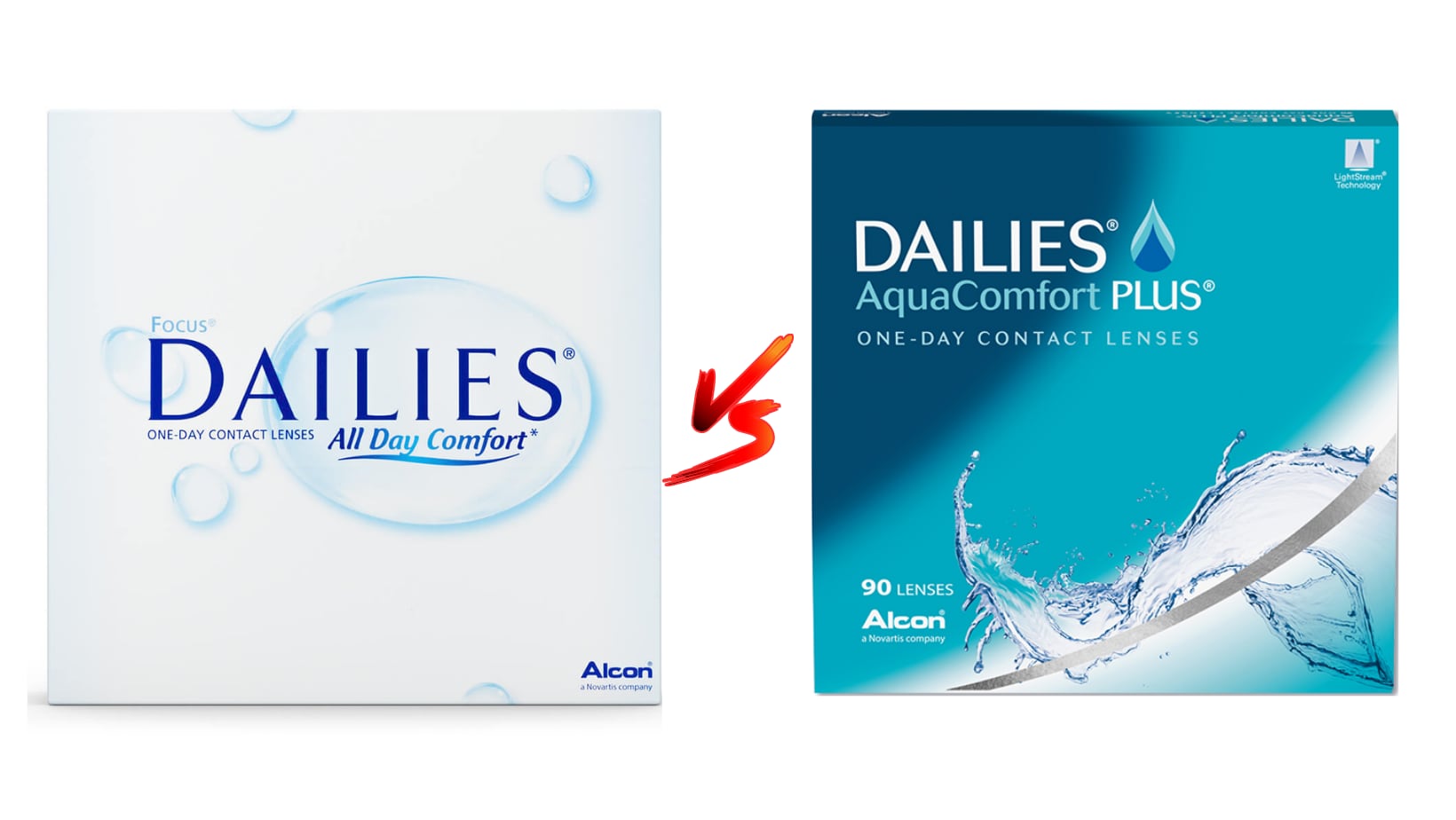
Eyeing the Options: Focus Dailies or Dailies Aquacomfort Plus?
-
Healthy Vision Month Checklist For Contact Lens Wearers
-

‘Eye Love You’: 5 Best Contact Lenses for Your Beloved This Valentine’s Day
-

US Truck Drivers’ Guide to the Best Contact Lenses for Night Driving
-

Makeup, Sweat, and Contact Lenses: Summer Eye Care Tips