
Contact lenses allow millions of people to enjoy clear, hassle-free vision. According to the Centers for Disease Control and Prevention, roughly 45 million Americans rely on them daily. While most people wear them without a hitch, some regularly struggle with a headache, accompanied by blurry vision, dryness, or eye fatigue.
Heavy screen use only adds fuel to the fire. A systematic review covering over 66,000 people found that 69% suffered from computer vision syndrome, known as digital eye strain, with that number climbing to 73.1% specifically among contact lens wearers. Headaches, blurred vision, and dry eyes are classic warning signs of this digital fatigue.
Paying close attention to when your symptoms flare up can help you figure out whether your contact lenses, screen habits, or another trigger needs adjusting.
Can Wearing Contacts Cause Headaches?
Not really. Contact lenses rarely cause headaches by themselves. Instead, the extra work your eyes do behind the scenes usually triggers that dull ache.
When your eyes work overtime to keep things in focus throughout the day, the muscle strain generated by that extra effort affects your temples. Meaning, it’s actually muscle fatigue, specifically the muscles that control your eye movement, that builds up into genuine discomfort.
Headaches have countless triggers. However, if a distinct, consistent pattern appears every time you pop contact lenses in, an eye exam from your eye care specialist (ECP) can easily help pinpoint whether your setup needs a simple adjustment.
Common Reasons Contacts May Be Giving You a Headache
Nevertheless, are you repeatedly suffering from headaches when wearing contacts? Here are the most common reasons your lenses might be causing extra strain.
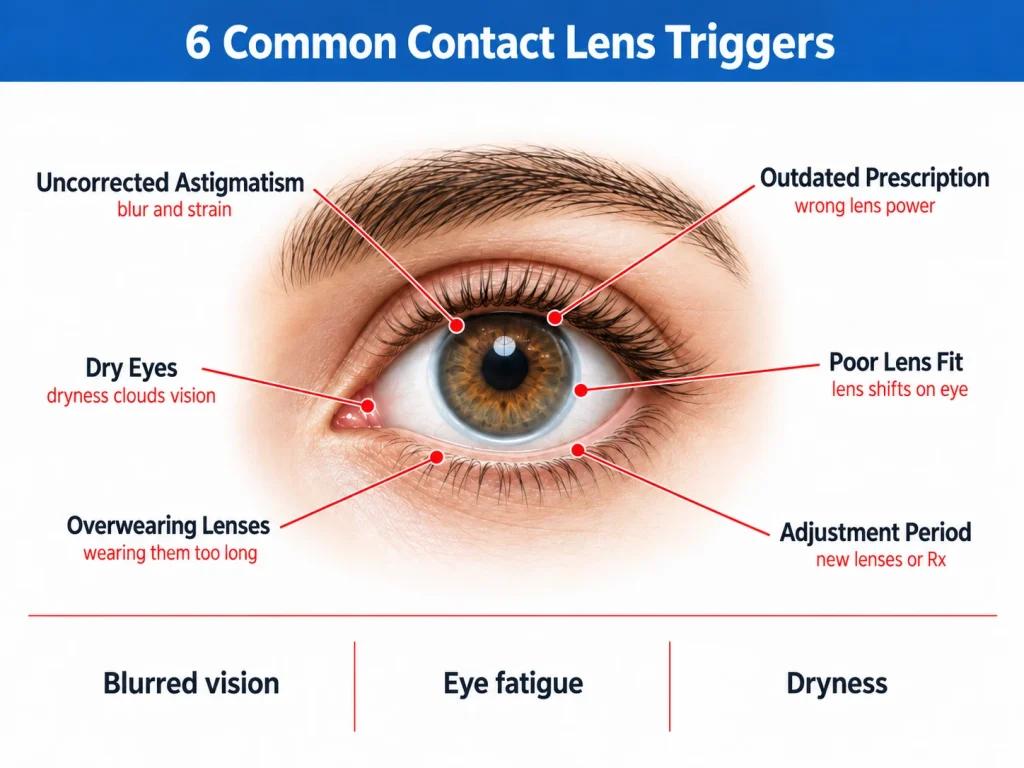
Your prescription is outdated or off.
Even a minor shift in your sight can leave images blurry enough to force your eyes to constantly adjust. That non-stop micro-adjustment and focusing effort easily turns into eye fatigue.
Your astigmatism isn’t fully corrected.
Uncorrected astigmatism creates subtle blurring or distortion at various distances. If your lenses aren’t properly compensating, your eyes will continuously strain to force images into sharp focus throughout the day.
Your lenses don’t fit your eyes properly.
Lenses need to sit in a stable position on your cornea to do their job properly. If a lens shifts around too much or fails to stay centered, your vision will blur, forcing your eyes to constantly refocus to make up for the movement.
Dryness is clouding your sight.
Staring at screens, hanging out in dry room air, or simply blinking less often can dry out your lenses and make your vision blur. Fighting through that dry, inconsistent sight is a fast track to tension around your eyes.
You’re wearing them past their limit.
Pushing your prescribed wear time starves your eyes of moisture. As the hours drag on and your vision loses stability, visual fatigue builds up quickly.
Your eyes are still adapting.
Switching to a new prescription or a totally different lens design requires an adjustment period for your brain and eyes. A little mild discomfort is normal at first, but persistent pain is a sign you should check in with your eye care professional.
How to Tell If Your Contact Lens Prescription Is the Problem
An outdated or wrong prescription forces your eyes to work double time just to keep images in focus. The warning signs aren’t always glaring either. Often, the first clue is a creeping pattern of head pain or fatigue that sets in after a few hours of wearing your lenses. Keep an eye out for these telltale signs that it’s time to get your eyes re-checked:
- Discomfort spikes while using digital devices.
Close-up tasks demand continuous focusing power. If your lenses aren’t providing the correct prescription, that non-stop exertion quickly leads to tension behind your eyes and across your forehead. - Your vision drifts or looks slightly blurry.
You might notice that fine print or distant street signs aren’t quite as crisp as they used to be. While persistent blurry vision usually signals an incorrect prescription, underlying dryness can also throw off your visual clarity. - You catch yourself squinting or constantly refocusing.
Squinting is your body’s natural reaction to narrow incoming light; you squint in an attempt to focus on a fuzzy image. If you’re doing this often while driving or reading, your current lenses are no longer pulling their weight. - One eye feels like it’s doing all the heavy lifting.
Small vision changes rarely happen at the same rate in both eyes. If one lens isn’t accurate to your visual needs for that specific eye, your brain has to work harder to blend the two mismatched images into a single clear view. - Headaches popped up right after a prescription update.
A short adjustment phase is normal when stepping up to a stronger lens power. However, if you continue to experience headaches well past the first week or two, your optometrist should double-check the match. - Your symptoms fade as soon as you take your contacts out.
Pay close attention to when the pain stops. If tension builds up whenever you wear contact lenses and disappears after removing them, your correction or lens parameters probably need a fine-tuning.
How to Relieve and Prevent Headaches While Wearing Contacts
If you frequently experience headaches while wearing your contacts, a quick audit of your daily habits, screen habits, and lens comfort is a great place to start. A few simple tweaks can dramatically ease visual fatigue.
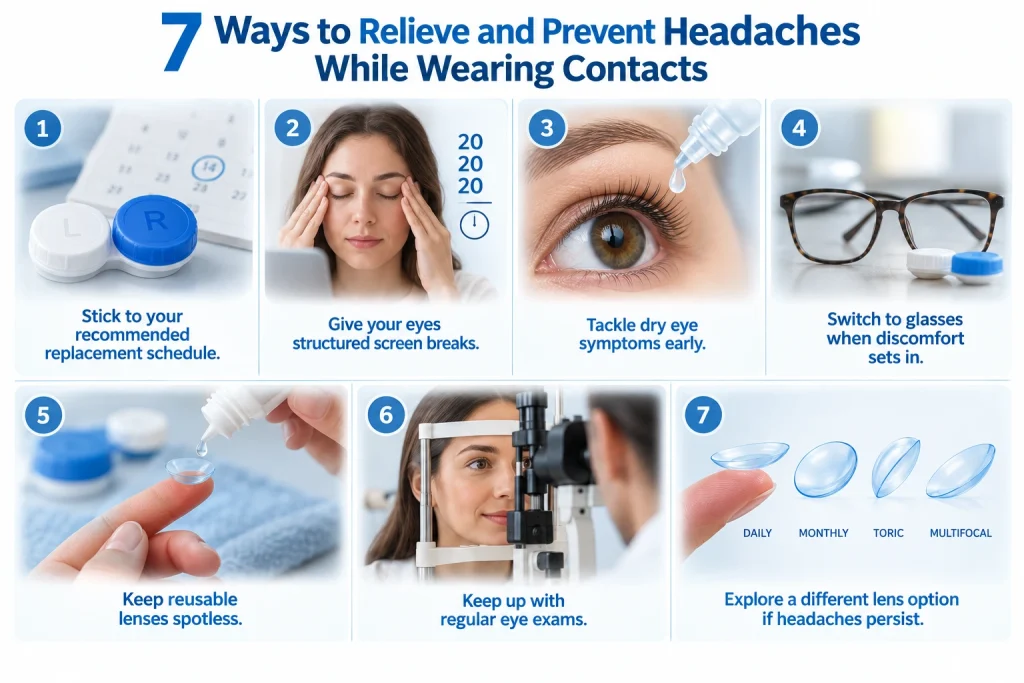
Stick to your recommended replacement schedule.
Always take your lenses out when advised and swap them for a fresh pair on time. Wearing your lenses past their expiration date causes moisture levels to plummet, leading to eye strain and tension.
Give your eyes structured screen breaks.
Staring at digital devices reduces your natural blink rate, drying out the lens surface and making your focusing muscles overwork. Use the 20-20-20 rule to periodically relax your eyes and restore moisture.
Tackle dry eye symptoms early.
If your lenses start feeling sticky or your vision gets hazy by late afternoon, don’t just push through it. Ask your optometrist if rewetting drops or switching to a daily disposable with higher water content would bring relief.
Switch to glasses when discomfort sets in.
Forcing your eyes to fight through blurry vision or physical irritation makes your visual system work overtime. Popping on your glasses gives your eyes a chance to rest while allowing you to continue to see things clearly.
Keep reusable lenses spotless.
Stick to a strict cleaning routine, and always use a fresh solution. Never top off old solution. Built-up deposits create friction, disrupt visual clarity, and make wearing your lenses far less comfortable.
Keep up with regular eye exams.
Your vision shifts gradually. Even subtle changes can force your eyes to struggle. Routine eye exams ensure your contacts are always supplying the sharp, effortless correction you need.
Explore a different lens option if headaches persist.
Every eye is unique, and factors like base curve, water content, and material matter immensely. If headaches keep popping up, your ECP can recommend an alternative design that better matches your eyes and lifestyle.
When Headaches Mean You Should Have Your Eyes Checked
An occasional headache does not always point to a contact lens problem. Still, consider scheduling an eye exam if you notice any of the following:
- Your headaches keep returning when you wear contacts.
A repeated pattern suggests that something about your vision correction or lens wear may be contributing to the problem. - Your vision stays blurry even with your contacts in.
Persistent blur can happen with an outdated prescription, an incorrect prescription, dryness, or a lens that does not sit properly on the eye. - Your headaches started after you changed prescriptions.
Some adjustment is normal, but continuous severe headaches should be checked. Your eye care professional can confirm whether you have the correct prescription. - One eye feels more strained than the other.
Uneven vision between the eyes can make your visual system work harder. A prescription difference, lens movement, or other vision issue may be responsible. - Your contacts have become uncomfortable after previously feeling fine.
New discomfort can point to dryness, changes in your eyes, or a poor fit. Don’t assume you simply need to get used to the lenses.
Some symptoms need more urgent attention. Remove your contacts and seek prompt eye care if you develop significant eye pain, marked redness, sudden vision changes, unusual light sensitivity, discharge, or persistent blurred vision. These symptoms can signal an eye problem that should not be treated as a routine headache.
Taking Control of Your Vision and Comfort

Contact lenses should deliver clear, effortless vision. If you’re regularly dealing with headaches from wearing contacts, it’s definitely a sign that warrants your attention. Whether the issue stems from an outdated prescription, a poor fit, everyday dryness, or simple digital eye strain, your eyes shouldn’t have to work this hard just to get through the day.
If those headaches keep coming back, start taking notes on when they occur and whether you experience them with blurry vision or tired eyes. Scheduling an eye exam is the single best step to uncover the root cause and get you back to comfortable, worry-free vision.
Disclaimer: This content is for general informational purposes only and is not a substitute for professional advice, diagnosis, or treatment.
What Else to Know About Contact Lenses and Headaches
Can contact lenses trigger a migraine?
Not usually, but eye strain, glare, or discomfort from contacts can trigger migraines in people who are prone to them.
Can contact lens solution cause headaches?
Rarely. Some solutions can irritate sensitive eyes, which may contribute to discomfort or eye strain.
Can switching between glasses and contacts cause headaches?
Yes. Your eyes and brain may need time to adjust to differences in image size, peripheral vision, and depth perception.
Can colored contact lenses cause headaches?
They can if the prescription is wrong, the fit is poor, or the lens design interferes with clear vision.
Can sinus headaches feel like they are caused by contact lenses?
Yes. Sinus pressure can cause pain around the eyes and forehead, making the discomfort feel related to your contacts.
Should you wear contact lenses during a migraine or severe headache?
You can remove them if they make light sensitivity, blur, or eye discomfort worse. Glasses may feel more comfortable until symptoms improve.
References
Visual Discomfort and Contact Lens Wear: A Review. Erin M. Rueff. Contact Lens and Anterior Eye. https://pubmed.ncbi.nlm.nih.gov/37277259/. June-04-2023. (pubmed.ncbi.nlm.nih.gov). Date Accessed: September 15, 2026.
Prevalence of Computer Vision Syndrome: A Systematic Review and Meta-Analysis. Al Tawil L, Aldokhayel S, Zeitouni L, Qadoumi T, Hussein S, Ahamed SS. Journal of Clinical Medicine. https://pubmed.ncbi.nlm.nih.gov/37866176/. October-31-2023. (pubmed.ncbi.nlm.nih.gov). Date Accessed: September 15, 2026.
Digital Display Use and Contact Lens Wear: Effects on Dry Eye Signs and Symptoms. Cristian Talens-Estarelles, José Vicente García-Marqués, Alejandro Cerviño, and Santiago García-Lázaro. Ophthalmic and Physiological Optics. https://pubmed.ncbi.nlm.nih.gov/35394083/. April-08-2022. (pubmed.ncbi.nlm.nih.gov). Date Accessed: September 15, 2026.
Effects of Residual Astigmatism in Contact Lens Wear on Visual Discomfort in VDT Use. N. P. Wiggins, K. M. Daum, and C. A. Snyder. Journal of the American Optometric Association. https://pubmed.ncbi.nlm.nih.gov/1583277/. March-1992. (pubmed.ncbi.nlm.nih.gov). Date Accessed: September 15, 2026.
Contact Lens Risks. U.S. Food and Drug Administration. https://www.fda.gov/medical-devices/contact-lenses/contact-lens-risks. September-04-2018. (fda.gov). Date Accessed: September 15, 2026.
Contact Lens Prescription. U.S. Food and Drug Administration. https://www.fda.gov/medical-devices/contact-lenses/contact-lens-prescription. October-28-2020. (fda.gov). Date Accessed: September 15, 2026.
Related Articles
-

Myokymia or Eye Twitching: Symptoms, Causes, and Treatment
-
Breakthrough in Ocular Medicine: 3D-Printed Contact Lenses that Deliver Medication
-

5 Ways Temperature Affects Your Contacts (and How to Fix It)
-

US Truck Drivers’ Guide to the Best Contact Lenses for Night Driving
-

How Does It Feel Wearing Contact Lenses For The First Time