If reading a text, checking a menu, or looking at a laptop feels harder than it used to, multifocal contacts are one way to handle that without wearing reading glasses over contacts. The goal is simple. One pair of contacts helps you see far away, at screen distance, and up close.
What Are Multifocal Contact Lenses?
Multifocal contact lenses have more than one prescription built into each lens. That means the same lens can support distance vision and close-up vision. Most people start looking into multifocals when near tasks get blurry with age, an early symptom of presbyopia.
What Is Presbyopia and What Are the Symptoms?
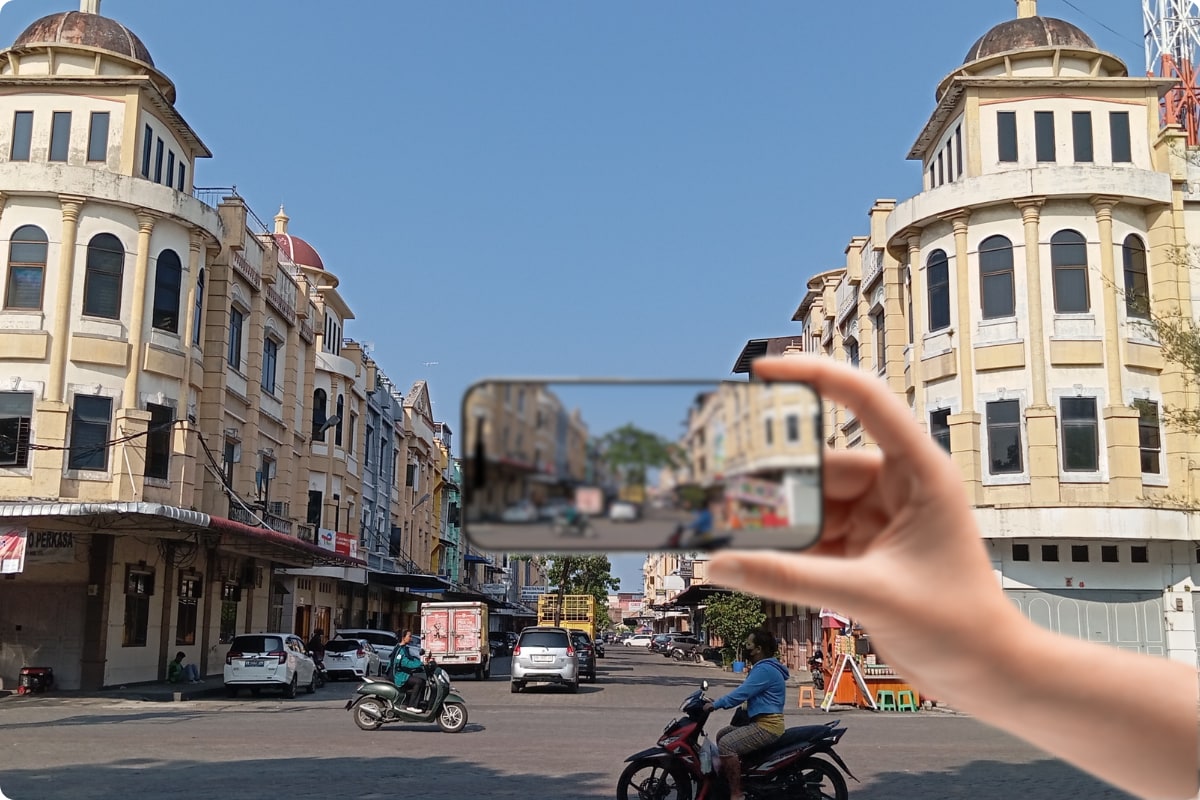
Presbyopia is an age-related change that makes it harder to focus on things up close. Over time, the natural lens inside the eye becomes less flexible, so shifting focus from far to near does not feel as effortless. It usually starts as a mild annoyance, like needing more light or moving your phone farther away, then becomes more noticeable during reading and screen time.
You might notice:
- Blurry small print when reading or texting
- Needing brighter light to read comfortably
- Holding a phone or menu farther away
- Eye strain after screen time or close work
- Headaches after reading
- Slower focus when shifting from near to far
Multifocal contact lenses are a great match for presbyopia because the same lens blends near and far vision, so you can move between reading, screens, and distance without swapping glasses.
How Do Multifocal Contacts Work
Think of multifocals like a lens with “more than one focus setting” built in. When you look far away, the distance part does more of the work. When you look at your phone, the near part matters more. When you look at a screen, the middle range helps.
You do not feel the lens switching. Your eyes and brain get used to using the part of the lens that matches what you are trying to see.
How Multifocal Contacts Blend Near and Far Vision
Multifocal contacts blend near and far vision by placing more than one focusing power into the same lens. Instead of using one prescription for distance and a separate one for reading, the lens is built so distance and near correction are both available at the same time, with a middle range that supports screen distance.
When you look far away, your eyes rely more on the distance power in the lens. When you shift to reading or your phone, your eyes rely more on the near power. You do not feel the lens changing modes. Your visual system naturally picks the clearest view for what you are looking at, which is how one pair of contacts can cover far vision, screens, and up-close tasks.
That blend can be built in a few different ways. Next, it helps to look at the most common multifocal contact lens designs and how each one handles near and far vision.
Common Multifocal Lens Designs
Concentric Designs

Concentric multifocals use rings, kind of like a target. One ring zone supports distance, another supports near, and some versions include help for screen distance too. Some lenses put distance in the center. Others put near in the center. The goal is the same. One lens covers more than one viewing range.
Aspheric Designs
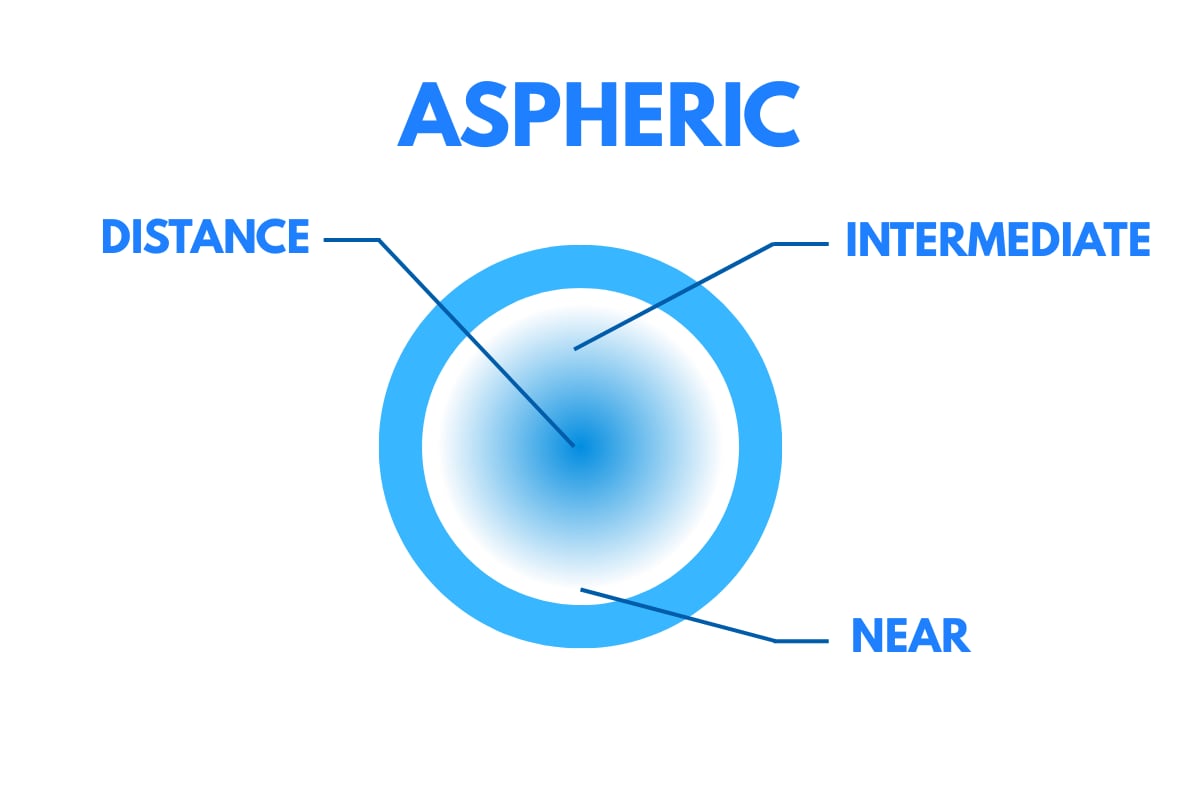
Aspheric multifocals do not use clear “ring steps.” The lens power shifts gradually from the center outward. Many wearers describe this as a smoother feel when switching between distance, screens, and reading. This design is common in soft multifocal contacts.
Segmented Designs
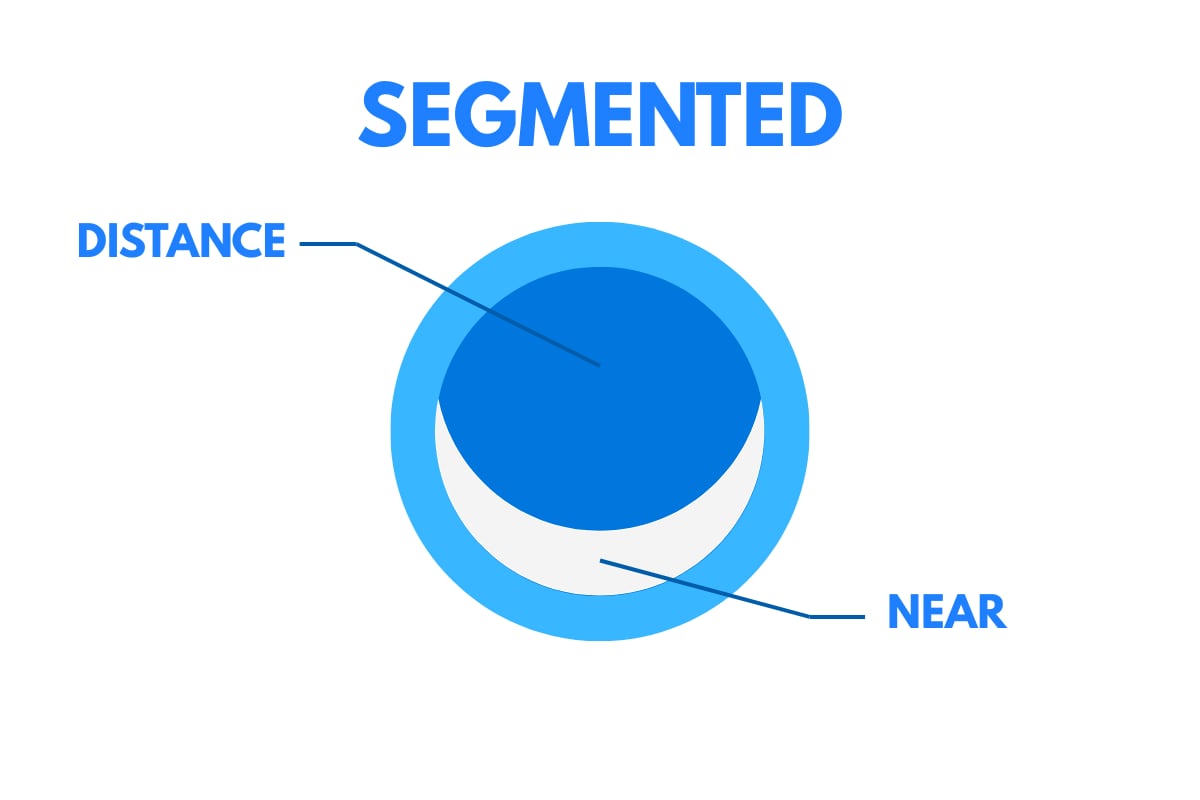
Segmented multifocals work more like a top and bottom layout, similar to a bifocal. When you look straight ahead, the distance portion does more of the work. When you look down to read, the near portion lines up better with your gaze. This design is more common in rigid gas permeable multifocals than soft lenses.
What to Expect When Using Multifocal Contacts for Screens and Night Driving
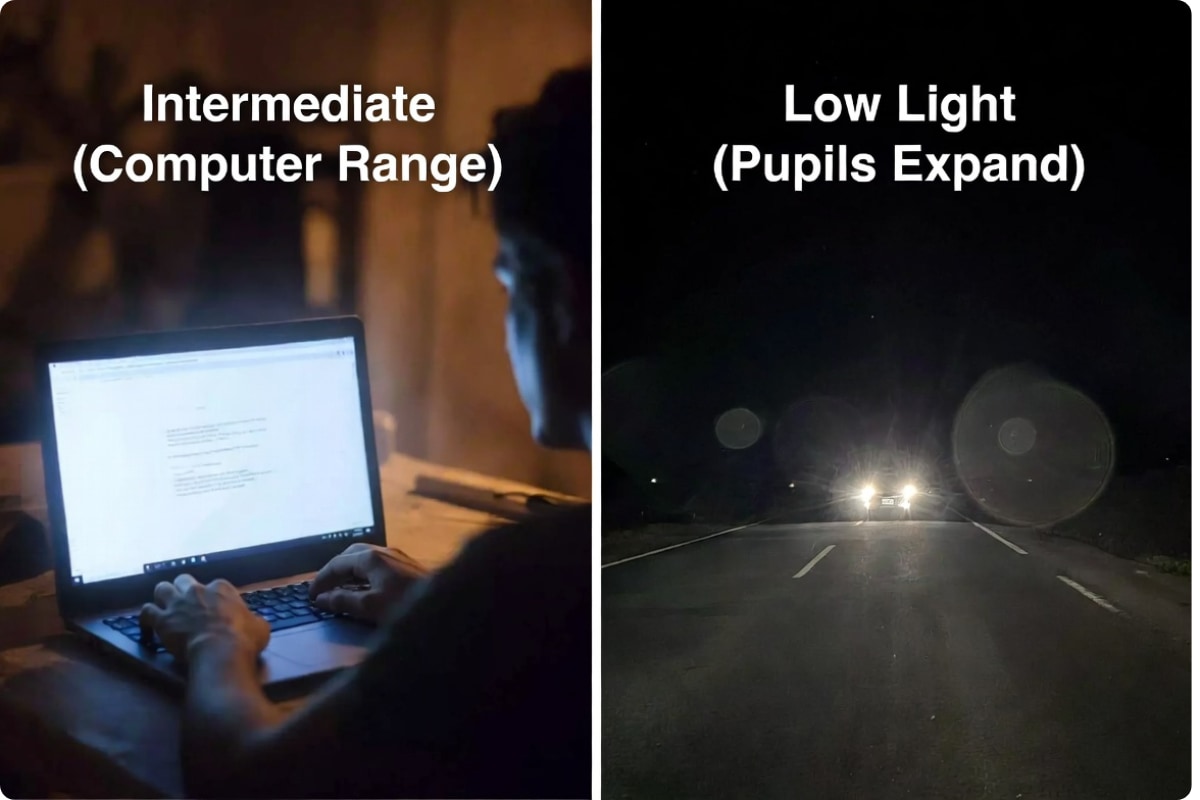
Multifocal contacts are doing a lot at once. The lens has to cover distance, computer range, and reading in the same small space, and your eyes have to get used to how that looks. Because of that, two situations tend to reveal small issues first: screens and night driving. If one of those feels slightly off early on, it is common and often fixed with a small tweak.
Screens and Computer Distance
Laptop and dashboard distance sits between far and reading, so it is often the first place text looks slightly soft. If screens feel off, an eye doctor can adjust the lens power, ADD, or design to sharpen that middle range.
Night Driving and Low Light
In dim light, your pupil gets bigger, which can make glare or halos around lights more noticeable early on. Many wearers see this settle down after some wear time. If it still feels distracting after a couple of weeks, a refit usually helps.
How Your Brain Learns to See Through Multifocal Contacts
Multifocal contacts work because your eyes take in more than one focus option at the same time. For a moment, your visual system receives both a distance-focused image and a near-focused image. That sounds messy, but your brain is good at sorting signal from noise.
Over time, your brain starts favoring the sharpest image for what you are doing. When you look across a room, the distance image tends to win. When you read a text, the near image becomes more dominant. For screens, the middle range has more influence. This is also why multifocals can feel strange at first. It is not the lens “switching.” It is your visual system learning which information to prioritize.
Best Multifocal Contact Lenses
| Best For | Product | Quick Note |
|---|---|---|
| Premium daily comfort |
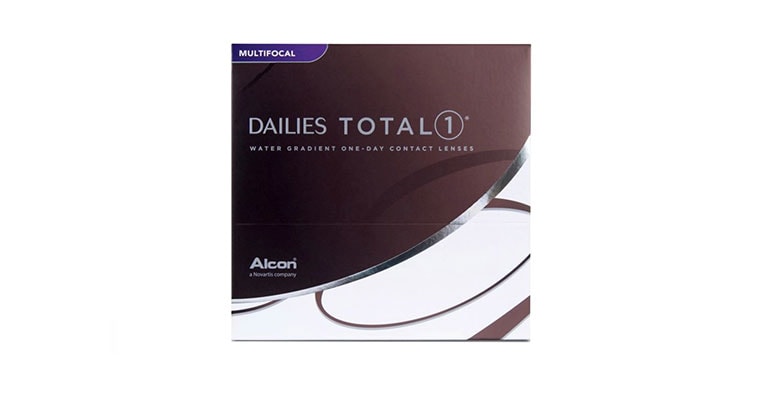
DAILIES TOTAL1 Multifocal
|
Daily lenses work well for comfort-focused wearers since you start with a fresh lens each morning. |
| Daily wear + UV blocking |
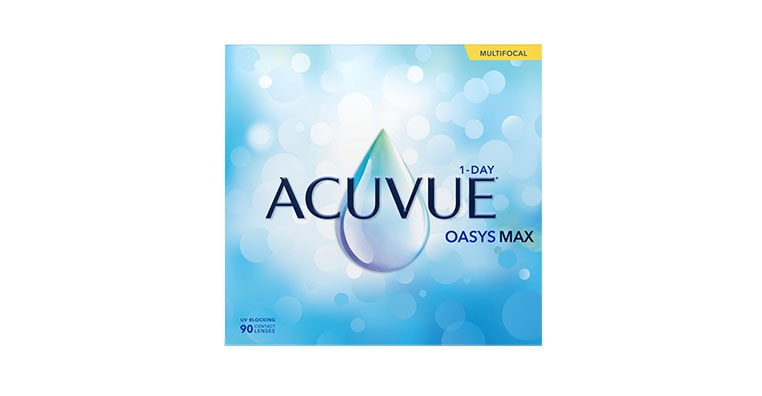
ACUVUE OASYS MAX 1-Day Multifocal
|
A daily multifocal with Class 1 UV blocking, great if you spend lots of time outdoors. |
| Daily wear with UV blocking |

1-Day ACUVUE Moist Multifocal
|
A simple daily multifocal pick with UV blocking for people who prefer an easy routine. |
| All-around monthly multifocal |
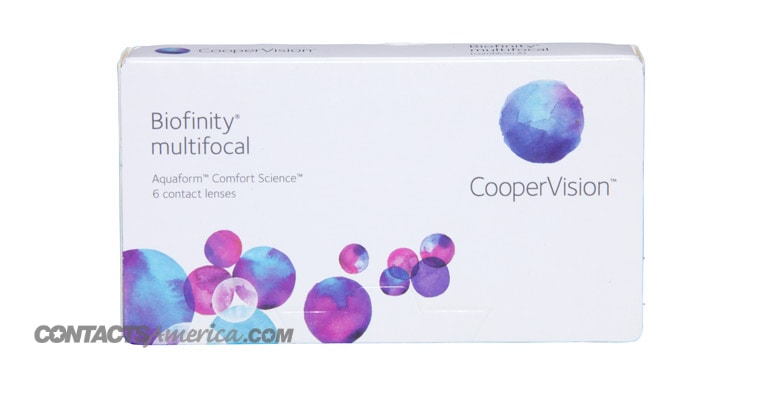
Biofinity Multifocal (6 Pack)
|
A popular monthly starting point for presbyopia since it balances everyday wear with once-a-month replacement. |
| Monthly comfort, dryness-focused |
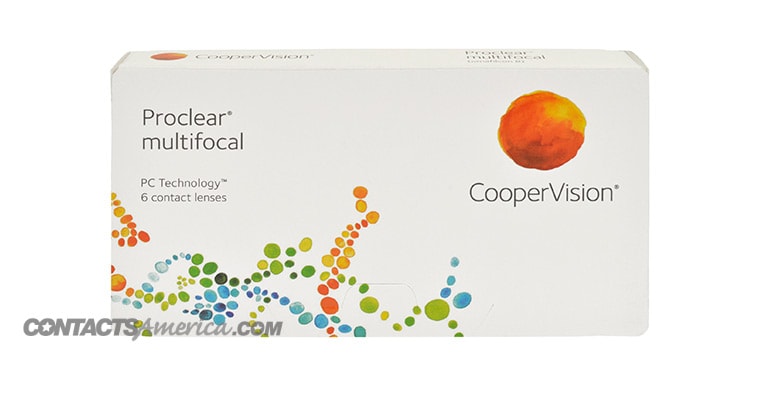
Proclear Multifocal (6 Pack)
|
A common choice for monthly wearers who notice dryness during long screen-heavy days. |
| Monthly with extended-wear option |
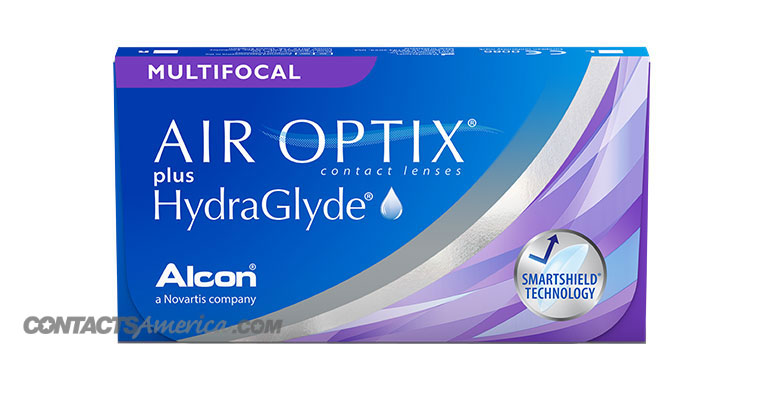
AIR OPTIX plus HydraGlyde Multifocal
|
Approved for daily wear and up to 7 days of extended wear, useful if you want that flexibility. |
| Monthly “thin-lens feel” style pick |
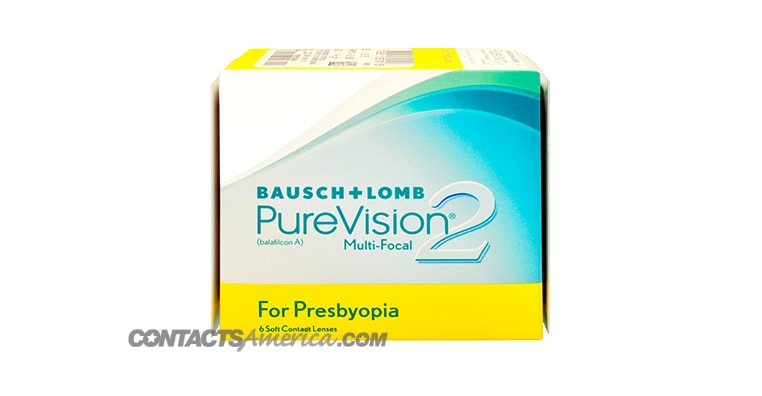
PureVision 2 Multi-Focal
|
A monthly multifocal that many wearers choose when they want a lighter, less “lens-aware” feel. |
| Presbyopia + astigmatism |
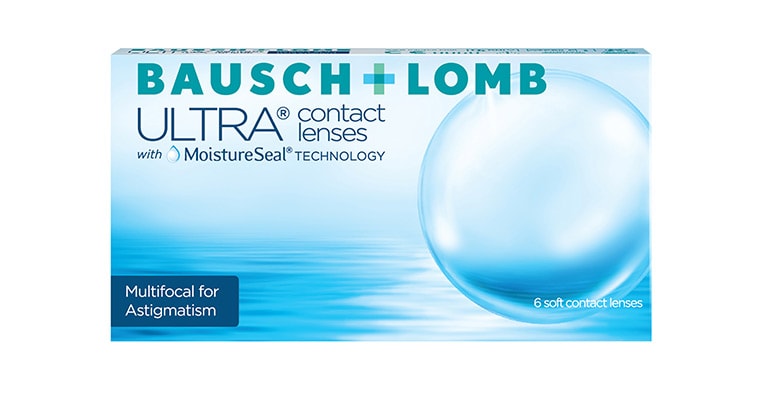
ULTRA Multifocal for Astigmatism
|
A multifocal toric option built for presbyopia and astigmatism, so vision stays more stable. |
Shop Multifocal Contact Lenses at Contacts America
If presbyopia is making reading and screen time harder, multifocal contacts can bring back that “easy focus” feeling, without reaching for reading glasses all day. Browse daily and monthly multifocal contact lenses on Contacts America, compare options by brand and wear schedule, and order the pair that matches your prescription.
Ready to get started? Shop multifocal contact lenses on Contacts America and place your order online today.
Frequently Asked Questions About Multifocal Contact Lenses
1. Do multifocal contact lenses work right away?
2. Can multifocal contacts replace reading glasses?
3. Are multifocal contacts good for computer work?
4. What does “ADD” mean on a multifocal contact lens prescription?
5. Can you get multifocal contacts if you have astigmatism?
6. Do multifocal contacts cause halos or glare at night?
7. Are multifocal contact lenses available as daily or monthly lenses?
8. What if multifocal contacts still feel blurry after a few weeks?
References
Presbyopia. National Eye Institute. https://www.nei.nih.gov/eye-health-information/eye-conditions-and-diseases/presbyopia. Date Accessed: February 9, 2026.
Presbyopia. American Optometric Association. https://www.aoa.org/healthy-eyes/eye-and-vision-conditions/presbyopia. Date Accessed: February 9, 2026.
What Is Presbyopia? American Academy of Ophthalmology. https://www.aao.org/eye-health/diseases/what-is-presbyopia. Date Accessed: February 9, 2026.
Presbyopia Treatment. American Academy of Ophthalmology. https://www.aao.org/eye-health/treatments/presbyopia-treatment. Date Accessed: February 9, 2026.
Contact Lenses for Vision Correction. American Academy of Ophthalmology. https://www.aao.org/eye-health/glasses-contacts/contact-lens-102. Date Accessed: February 9, 2026.
About Contact Lenses. Centers for Disease Control and Prevention. https://www.cdc.gov/contact-lenses/about/index.html. Date Accessed: February 9, 2026.
Contact Lens Prescription. U.S. Food and Drug Administration. https://www.fda.gov/medical-devices/contact-lenses/contact-lens-prescription. Date Accessed: February 9, 2026.
The Contact Lens Rule: A Guide for Prescribers and Sellers. Federal Trade Commission. https://www.ftc.gov/business-guidance/resources/contact-lens-rule-guide-prescribers-sellers. Date Accessed: February 9, 2026.
Bifocal and Multifocal Contact Lenses for Presbyopia and Myopia Control. PubMed Central (National Library of Medicine). https://pmc.ncbi.nlm.nih.gov/articles/PMC7152962/. Date Accessed: February 9, 2026.
Fine-Tune Your Multifocal Lens Fitting. Contact Lens Spectrum. https://www.clspectrum.com/issues/2018/june/fine-tune-your-multifocal-lens-fitting/. Date Accessed: February 9, 2026.
Contact Lenses 101, Part 2: Contact Lens Designs. CooperVision. https://coopervision.com/practitioner/ecp-viewpoints/technicians-and-staff/contact-lenses-101-part-2-contact-lens-designs. Date Accessed: February 9, 2026.
Related Articles
-

Can Contact Lens Solution Be Used as Eye Drops? Safety Risks and What to Do Now
-

How Coastal Humidity Affects Contact Lens Comfort
-

5 Ways Temperature Affects Your Contacts (and How to Fix It)
-

All You Need to Know About RGP Contact Lenses: Are They Right for You?
-

Eye to Eye: Decoding the Differences Between Toric and Multifocal Lenses