You’re sitting across from your best friend at your favorite table, laughing over a shared plate of fries just like you’ve done a hundred times before. You’ve secretly carried a flame for them for months. As you look up mid-sentence, you catch their gaze. The casual laughter fades, and for a split second, their eyes seem to bloom wide, swallowing the light, and painting their gaze in a soft shadow that leaves you breathless.
It feels deeply intimate, as if their eyes are stretching just to drink in every detail of you.
Why do someone’s eyes seem to darken when they look at you like that? Is it a glimpse of hidden feelings, or just a trick of the light?
The Secret of a Softly Darkening Gaze
There’s a kind of breathtaking magic in the way we look at someone who makes our heart race. While the true color of your iris remains unchanged, love has a way of painting over reality. When you lock eyes with someone you like, a subtle, irresistible transformation takes place. Your gaze deepens, softens, and darkens, turning a shy glance into an unspoken confession.
Your body surrenders to the moment. Your pupils dilate, opening wide to drink in every detail of that person’s face. As those dark centers expand, they swallow the lighter flecks of your iris, casting a beautiful, velvet shadow over your eyes.
Paired with a softened expression and a lingering, breathless focus, your gaze becomes deeper, warmer, and irresistibly intriguing.
Your eyes darkening is a tender signal that whispers, I want to see more of you long before words are spoken.
When the Heart Commands Your Eyes to Open Wide
The secret behind that dreamy, romantic gaze lies within your pupils, those little black round centers of your eyes that stretch wide to let the light in. When someone special captures your heart, your nervous system responds with a quiet rush of wonder, dilating your pupils and giving your eyes a mesmerizing depth.
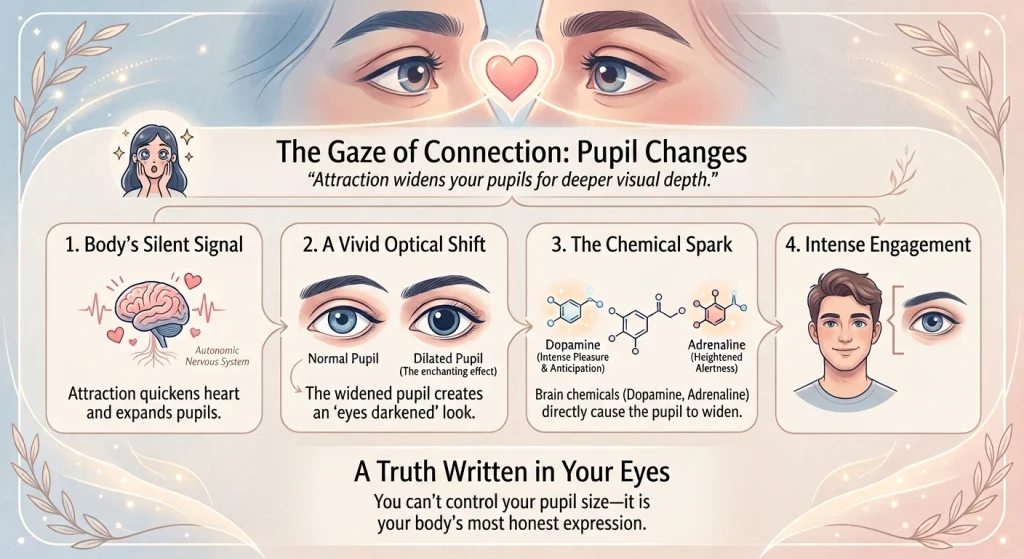
Your autonomic nervous system responds to desire.
When attraction ignites, your autonomic nervous system steps in. It seamlessly coordinates your body’s involuntary arousal responses, quickening your heart rate, altering your breathing, and widening your pupils to reflect the rush of attraction.
Pupil dilation creates a striking visual contrast.
As your pupils expand, they take over more of the iris, overshadowing the lighter pigment of your iris. This dramatic shift creates that enchanting optical effect that your eyes have suddenly darkened. This pupil dilation goes by the very unromantic name: mydriasis.
Neurotransmitters spark the physical transformation.
The brain floods your system with dopamine, driving intense pleasure and anticipation, and adrenaline, which sparks heightened alertness. This delicate neurochemical cascade works behind the scenes to directly induce mydriasis.
Dilation signals profound cognitive and emotional focus.
In psychology and neuroscience, larger pupils are linked to deep visual engagement and heightened attention. During an intimate shared moment, this physical reaction transforms your look into an intensely expressive, soul-stirring gaze.
Pupil dilation is an involuntary biological confession.
You can give your special someone a warm smile. You can look them in the eye. But you can’t choose not to do that with your pupil’s size. Pupil dilation is governed without conscious control. It’s one of your body’s most honest vulnerabilities.
The Transformation of a Glance
Attraction softens the whole world around you. When love stirs within you, your emotions overflow into every glance, making your gaze appear softer, deeper, and more enchanting. Around someone who makes your heart flutter, genuine joy and sweet nervousness shine through your face with the subtlest shifts, turning a simple look into a breathtaking expression of affection.

When you’re drawn to someone, your gaze lingers on them. This lingering attention transforms ordinary moments into shared secrets. Steady, devoted eye contact quietly whispers a desire to stay close and be fully present in such a special moment.
Love also touches the delicate muscles around your eyes. A heartfelt smile crinkles the corners of your eyes, softening your expression into something radiantly tender. Your eyes appear brighter and more open, inviting the other person to fall a little deeper.
We often call the eyes the windows to the soul. They refuse to hide what the heart truly feels. While romantic attraction will never alter the color of your iris, the sweet harmony of dilated pupils, tender expressions, and lingering glances paints your eyes in a truly romantic light.
Candlelight and Chemistry Working Together
Do you know that things you can’t control can also conspire to deepen the romance of the moment? Shadows, soft reflections, and natural optical changes weave together with emotion.

- Soft lighting wraps your gaze in deep shadow. Warm, dimmed settings such as a twilight date or a candlelit dinner naturally enlarge your pupils and sharpen the contrast against your iris.
- Surrounding colors bring out hidden depths. The subtle hues of your clothing, makeup, or the ambient backdrop frame your face like a portrait. Complementary shades draw out the deepest tones within your iris, making every glance feel more vivid.
- A gentle veil of moisture adds a romantic sparkle. Emotional moments bring a touch of extra tears to your eyes, catching the light like liquid glass. This sheen makes your gaze sparkle.
- Perspective amplifies the intensity of a close look. Leaning in close alters how light and shadow hit your face, deepening the visual drama of your features. Up close, every fleck of pigment and the deep expanse of your pupil feel far more intimate.
- Constant, natural shifts keep your gaze mesmerized. Throughout the day, your eyes naturally adapt to light, distance, and feeling. These continuous, subtle adjustments mean that every time they look at you, your eyes offer a slightly different, captivating view.
Finding True Affection Beyond a Darkened Gaze
While dilated pupils are hints of desire, the eyes are only the opening chapter of a romantic story. True affection reveals itself best when these quiet glances are backed by the tender, unmistakable rhythms of other actions.

- They quietly seek your presence. Someone falling for you will gently find excuses to be near. They look for reasons to sit beside you, linger a little longer before saying goodbye, or turn a brief greeting into a sweet, endless conversation.
- They treasure the small details you share. Nothing you say is ever forgotten. They recall your favorite coffee order, the little fear you whispered about in passing, or an upcoming event you were nervous about. They hold onto your words like precious keepsakes.
- Their body language softly leans into yours. Attraction creates an invisible pull that brings them closer. They naturally turn their shoulders toward you, lean in when you speak to catch every word, and unconsciously mirror your gentle gestures, creating an unspoken dance of harmony.
- They cultivate a steady, comforting rhythm of connection. True romantic interest doesn’t fade when you walk away. They reach out with thoughtful messages, keep conversations alive, and make an effort to remain a constant, warm presence in your daily life.
- They reserve a special, playful warmth just for you. Pay attention to how their demeanor shifts in your presence. Soft laughter, gentle teasing, unexpected compliments, and a tender, quiet tone of voice all signal that you hold a special, cherished place in their heart.
- They long to know you deeper. Genuine devotion carries a sweet curiosity. They ask thoughtful questions about your dreams, your quietest memories, and your wildest opinions, eagerly seeking to understand the world hidden behind your eyes.
The Secret Romance Written in Your Eyes
The quiet language of your eyes isn’t a trick of color, but an unspoken surrender of the heart. It’s a breathtaking miracle in how the body whispers our secrets before we decide to spill out our heart to a special someone. When those soul-stirring eyes are paired with a steady presence, cherished memories, and an eager desire to hold you close, that fleeting, mysterious look turns into something true and wonderful.
Disclaimer: This content is for general informational purposes only and is not a substitute for professional advice, diagnosis, or treatment.
Frequently Asked Questions
-
There’s no fixed duration. Pupils can expand and contract within seconds as your level of emotional arousal, attention, and surrounding light changes.
-
Potentially. Thinking about someone who produces a strong emotional response can affect physiological arousal, which can influence pupil size.
-
Not necessarily. People differ in their physiological responses. The apparent change can be much easier to notice in some eyes than others.
-
Yes. Blue, green, gray, and other lighter irises generally create stronger visual contrast with the black pupil. When the pupil expands and occupies more of the visible iris, the resulting darker appearance can therefore be particularly noticeable.
-
Yes. Certain medications, eye drops, drugs, neurological conditions, and eye injuries can cause unusually large pupils or changes in pupil response.
References
The Pupil as a Measure of Emotional Arousal and Autonomic Activation. Bradley MM, Miccoli L, Escrig MA, Lang PJ. Psychophysiology. https://pubmed.ncbi.nlm.nih.gov/18282202/. July-2008. Date Accessed: August 27, 2026.
The Effects of Emotional Arousal on Pupil Size Depend on Luminance. Samling E, et al. Attention, Perception, & Psychophysics. https://pubmed.ncbi.nlm.nih.gov/39300137/. September-2024. Date Accessed: August 27, 2026.
Love Is in the Gaze: An Eye-Tracking Study of Love and Sexual Desire. Bolmont M, Cacioppo JT, Cacioppo S. Psychological Science. https://pubmed.ncbi.nlm.nih.gov/25031302/. July-2014. Date Accessed: August 27, 2026.
Sharing and Receiving Eye-Contact Predicts Mate Choice After a 5-Minute Conversation: Evidence from a Speed-Dating Study. Hietanen JK, et al. Scientific Reports. https://pubmed.ncbi.nlm.nih.gov/38379110/. February-2024. Date Accessed: August 27, 2026.
Pupillometry: Psychology, Physiology, and Function. Mathôt S. Journal of Cognition. https://pmc.ncbi.nlm.nih.gov/articles/PMC6634360/. June-2018. Date Accessed: August 27, 2026.