Myopia can creep up quietly, and a lot of it comes down to everyday indoor habits you don’t think twice about. Your child can seem “fine,” then suddenly start squinting at distant objects or moving closer to screens and books as their distance vision changes.
When parents ask if dim light causes child myopia, the most accurate answer is: it’s rarely just one thing. Research keeps pointing to a combination of patterns, especially low light and sustained near work, plus less time spent outdoors in brighter light, which appears protective across many studies.
Does Dim Light Cause Child Myopia?
- Dim lighting by itself is unlikely to be the only cause. Still, low indoor lighting during long homework/reading sessions may contribute to some kids.
- The strongest, repeatable pattern is outdoor light: kids who spend more time outdoors tend to have a lower risk of developing myopia, and it may help slow myopia progression once it starts.
- A newer research idea is that prolonged close-up focus indoors, especially in dim light, can reduce the amount of light reaching the retina during near work, which may help explain why “near work + low light” appears in discussions of myopia.
- Your most practical move at home: brighten the reading/homework area, keep the page/screen at a reasonable distance, and build in breaks (many eye doctors teach the “look far away regularly” approach during near work).
- Prioritize outdoor time daily, especially if myopia runs in the family or you’re already seeing myopia symptoms in children (squinting, sitting close to screens, trouble seeing far).
If you’re worried, don’t guess. A regular eye exam can confirm whether your child is developing myopia and whether it’s time to discuss myopia control options.
UV 101 for Parents: “Dim Light” vs Bright Light
What “Dim Light” Means in Real Life
When parents say “dim light,” they usually mean homework or reading in a room where the corners look shadowy, the page is not evenly lit, or your child keeps angling the book or tablet to “find the light.” Think: a single lamp across the room, a small nightlight, or an overhead light that is on but still feels gloomy at the desk.
A “well-lit” setup is simpler than it sounds. It just means your child’s work area is evenly bright enough that they can read comfortably without squinting, leaning in, or moving the page around. Outdoors is a different category. Even on cloudy days, daylight is typically much brighter than most indoor lighting, which is why time spent outdoors keeps showing up in myopia research.
Why The Eye React Differently in Dim Light
In dimmer lighting, the pupil opens wider to let in more light. That can make vision a little less “sharp,” especially up close, because the eye has to work harder to keep things clear. Add long stretches of close focusing, and you get a double challenge: more effort to focus and fewer visual breaks.
This is also why reading in dim light affects your eyesight is such a common question. Dim light does not “ruin” eyesight by itself. Still, it can make near work feel harder and encourage habits that raise risk over time, like holding screens very close or doing long, uninterrupted reading blocks.
What the Research Suggests about Dim Light and Myopia
Most of the concern is not “dim light on its own.” It’s the combo of low indoor light plus prolonged near work, especially if a child is already in a high-risk group (strong family history, fast prescription changes, lots of near work). Some newer research suggests that close work in low light may reduce the amount of light reaching the retina and could play a role in myopia progression in some kids.
What this means in real life is practical: if your child is doing homework, reading, or screen time, and myopia in children is already a worry in your house, improving the lighting at the desk is a low-effort change that supports healthier visual habits.
- Treat lighting as part of your child’s study setup, not as a “myth vs fact” debate.
- Focus on the pattern: long near work + low light + few breaks is the riskier mix.
- A brighter work spot plus regular breaks supports myopia prevention in children better than trying to “power through” in a darker room.
Across many studies, the most consistent protective factor is more outdoor time in bright light. That does not guarantee your child will avoid myopia. Still, it is one of the strongest habits linked with a lower risk of developing myopia, especially in school-aged children.
If you’re noticing signs of myopia in children, like squinting at distance, sitting very close to screens, or trouble seeing the board, it’s best to schedule a regular eye exam rather than trying to solve it with lighting changes alone.
Nightlights and “Reading in the Dark”: Myths vs Facts
Myth: Nightlight causes nearsightedness
Fact: Early headlines made it sound that way, but follow-up research found the “nightlight link” often fades when you account for family history and other factors. A nightlight by itself is not a reliable explanation for myopia in children.
What To Do: Keep bedtime lighting calm and low for sleep, but don’t treat a nightlight as the reason your child might develop nearsightedness.
Myth: Reading in the dark is always the problem
Fact: The bigger concern is repeated, long, close-up focusing, especially when the room is poorly lit, and your child stays locked into near work for a long stretch. In other words, it’s less about a single moment and more about patterns that may add to myopia progression over time.
What To Do: If you’re worried about whether reading in dim light affects your eyesight, focus on the routine: better lighting + shorter near-work blocks + more breaks.
The Bigger Drivers Parents Can Control
Outdoor Time
Think of outdoor time as your easiest “stackable” habit for myopia prevention. Many kids benefit from aiming for about 2 hours a day outside when possible, especially during the school-age years, when myopia in childhood often first appears.
Simple ways to make it realistic:
- Walk part of the way to school, or add a short after-school walk.
- Encourage outdoor recess when available.
- Pick one weekend “outdoor block” (park time, biking, sports, playground).
If myopia runs in your family, time spent outdoors becomes even more worth prioritizing because your child may already have a higher risk of developing myopia.
Near Work Habits
You don’t have to ban books or homework. You want to make near work “friendlier” for your child’s eyes, especially during heavy study seasons.
Use a simple checklist:
- Keep reading or screens at a comfortable distance (not right up to the face).
- Encourage posture that keeps the head up and the work supported, not hunched.
- Build in breaks, such as a “look far away” reset every 20 minutes or so, especially during homework marathons.
- Break big assignments into smaller chunks so your child isn’t doing sustained close-up focus for an hour straight in low light.
Screens vs Total Near Work
Screens get blamed a lot, but the more useful idea is “total close-up time.” Tablets, books, homework packets, phones, and handheld games all count as near work.
If your child has long homework nights, try to balance it with outdoor play earlier in the day, keep the desk well-lit, and avoid stacking a second long block of close-up screen time right after. This approach is more helpful than obsessing over whether dim-light myopia comes solely from screens.
Try a few digital detox eye health habits that make breaks feel more doable if screens are a big part of your child’s day.
Home Lighting Setup That’s Doable
Good lighting will not “cure” child myopia, but it can make near work easier on your child’s eyes and reduce the temptation to lean in close. Think of it as one practical piece of myopia prevention in children, along with breaks and more time spent outdoors.
Homework and Reading Lighting
Do This
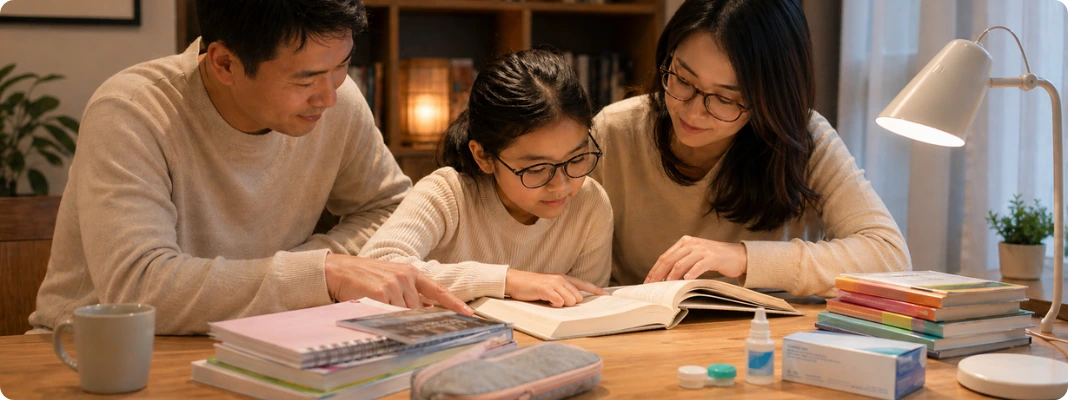
- Turn on an overhead light first, then add a desk lamp for the page or workbook so the whole area feels evenly lit.
- Aim the lamp so it lights the page without shining into your child’s eyes or casting a dark shadow where they’re writing.
- Keep the screen brightness at a comfortable level and reduce glare by adjusting the screen angle and the room lighting together.
- Set up the chair and desk so your child can sit upright instead of hunching forward to “find the light,” which often turns into close viewing.
Avoid This
- A single small lamp in an otherwise dark room, where the page looks bright, but the rest of the room feels dim.
- Reading or homework with the light behind your child, which can throw shadows across the page.
- Glare-heavy setups, like a bright lamp reflecting off glossy paper or a tablet screen.
Bedroom lighting and winding down
Do This
- Keep bright homework lighting earlier in the evening, then transition to calmer lighting closer to bedtime.
- If your child likes to read before sleep, use a soft bedside lamp that lights the book clearly without lighting up the whole room.
- If you use a nightlight, keep it dim and indirect to enhance comfort and safety without turning the bedroom into a “work zone.”
Avoid This
- Long reading sessions in very low light right before bed, especially when your child is already tired and blinking less.
- Homework in bed, where posture and viewing distance usually get too close.
Quick Parent Checks
- If the room feels dim enough that your child has to lean in close to see clearly, brighten the space.
- If you notice your child moving the book or tablet closer over time, fix the lighting and reset the setup before assuming it’s only a habit.
- If your child complains that letters “look fuzzy” or they need to squint during homework, treat that as a sign to improve lighting and consider a regular eye exam.
Signs Your Child May Be Developing Myopia
Many myopia symptoms in children show up in everyday routines, not as a major complaint. Watch for patterns that repeat across schools, screens, and distance-viewing.
- Squinting at distant objects like the TV across the room or signs outside.
- Moving closer to the board at school or sitting closer to screens at home.
- Complaining that distance vision is “blurry,” especially later in the day.
- Headaches or eye fatigue after school, reading, or screen time.
- Holding books, tablets, or phones unusually close.
- Saying letters “double” or look shadowy, especially in lower light or when they’re tired.
If you are unsure what counts as “mild” versus “needs an exam,” this quick guide on understanding 20/40 vision can help you frame what your child might be experiencing.
Book an exam if your child is seeing repeated distance blur, frequent squinting, or a clear “getting closer over time” pattern, even if your child says they can still see “fine.”
When to Book an Eye Exam and What to Ask
If you’re wondering when to get a child’s eye exam, use this simple rule: book sooner when symptoms show up, and do not wait for grades or behavior to change first. Myopia can progress quietly, and catching it early helps you understand your options for slowing myopia progression.
If your child already has myopia, your eye doctor may recommend a follow-up schedule based on how fast their prescription is changing. If myopia runs in the family, it’s also smart to get ahead of it with a baseline exam and a clear monitoring plan.
It helps to know that contact lens prescriptions aren’t the same as glasses prescriptions if you’re also considering contacts for your child later on.
Treatment Options That Slow Progression
If your child already has child myopia (nearsightedness), the goal is usually two-part: keep vision clear today and slow myopia progression over time. Your eye doctor will choose options based on your child’s age, prescription, eye health, and how quickly things are changing at each regular eye exam.
| Option | Best For | Notes |
|---|---|---|
| Low-dose atropine (doctor-prescribed drops) | Kids with progressive myopia in children, especially when progression is steady year to year | Dosing and timing are provider-guided, and your doctor will monitor side effects and response over follow-ups. |
| Myopia-control soft contacts (example: MiSight) | School-aged kids who can handle contact lens hygiene with parent support | MiSight is an FDA-approved myopia-control daily disposable contact lens for certain children (your doctor will confirm age and eligibility). These are different from standard daily lenses. |
| Orthokeratology (Ortho-K) | Families who prefer daytime freedom from glasses/contacts and can manage a strict nightly routine | These are rigid lenses worn overnight to reshape vision for daytime; many clinics use them in myopia management plans, but fit and follow-up are critical. |
| Myopia-control glasses strategies (provider-guided) | Kids not ready for contacts or families who want a simpler routine | Ask your doctor about myopia-management spectacle lens designs available in your area and whether they’re appropriate for your child’s prescription and lifestyle. |
| Lifestyle plan: more outdoor time + better near-work habits | Most kids, especially those with family history or heavy near work | This supports myopia prevention in children and can be part of myopia control in children. Think “more time spent outdoors + fewer marathon close-up sessions,” not perfection. |
If your child is new to contacts, this first-time contact lens user guide is a helpful overview of what to expect and what you’ll need at home.
Best Contact Lens for Children With Myopia
Just keep one important distinction clear: these options help correct distance vision, but myopia control in children requires specific designs and a doctor-guided plan.
1. ACUVUE OASYS MAX 1-Day
This daily silicone hydrogel lens is designed for breathable comfort during long school days, especially when your teen is bouncing between screens and indoor air conditioning. It can help keep vision correction feeling more stable and comfortable throughout the day, especially when dryness or fatigue tends to set in. While it helps correct myopia clearly, it does not “fix” myopia progression unless your eye doctor specifically prescribes a myopia-control design and fit plan.
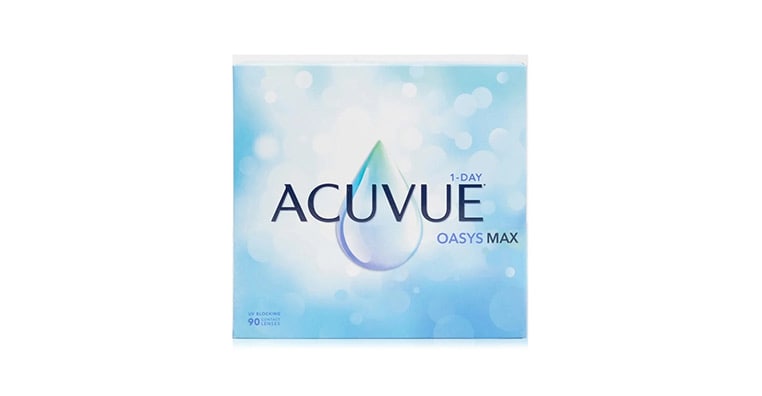
Explore ACUVUE OASYS MAX 1-Day if your teen needs a daily lens that stays comfortable through screen-heavy routines.
2. ACUVUE OASYS 1-Day with HydraLuxe
This daily silicone hydrogel lens uses a comfort-focused design intended to support a smoother, more consistent wearing experience through long wear hours. It can be a good fit discussion if your teen’s day includes close-up work, classroom screens, and after-school activities where comfort drops late. It corrects myopia for clear vision, but slowing progression requires a doctor-guided myopia-control plan beyond standard daily lenses.
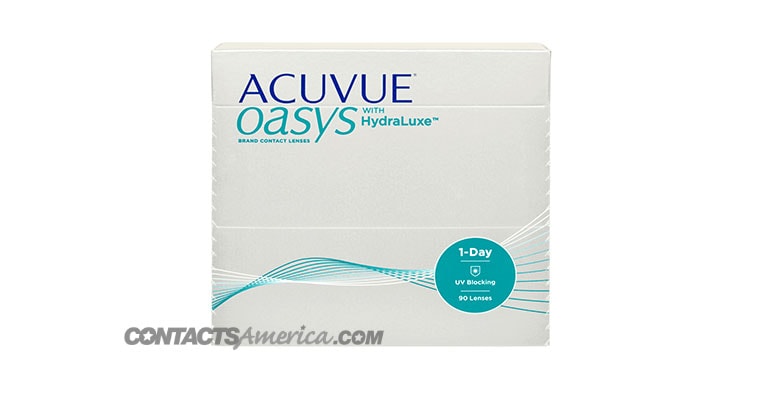
Ask your eye doctor about ACUVUE OASYS 1-Day with HydraLuxe if comfort and consistency are your priorities on busy school days.
3. DAILIES TOTAL1
This daily lens is known for its water-gradient surface, which can feel very smooth, which may help if your teen complains that lenses feel dry or “present” later in the day. Because it is a daily disposable, it also removes solution and case variables that can contribute to irritation or inconsistent comfort. It corrects myopia effectively for day-to-day vision, but it is not a myopia-control treatment unless your eye doctor recommends a specific myopia-control option.
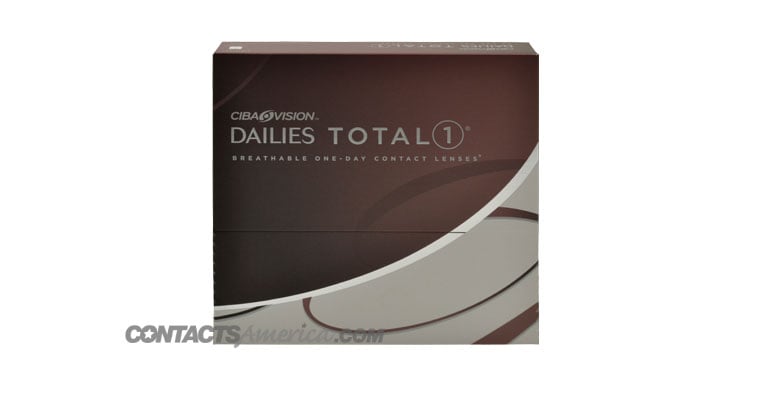
Consider DAILIES TOTAL1 if your teen wants a premium comfort feel with a simple daily routine.
4. PRECISION1
This daily silicone hydrogel lens includes a moisture-focused surface design that can help support comfortable, clear wear during normal school and activity schedules. It is often a practical option for teens because the daily format reduces the number of handling steps and helps keep routines consistent. It corrects myopia for clear distance vision, but controlling progression requires your eye doctor’s guidance and a myopia-control strategy when appropriate.
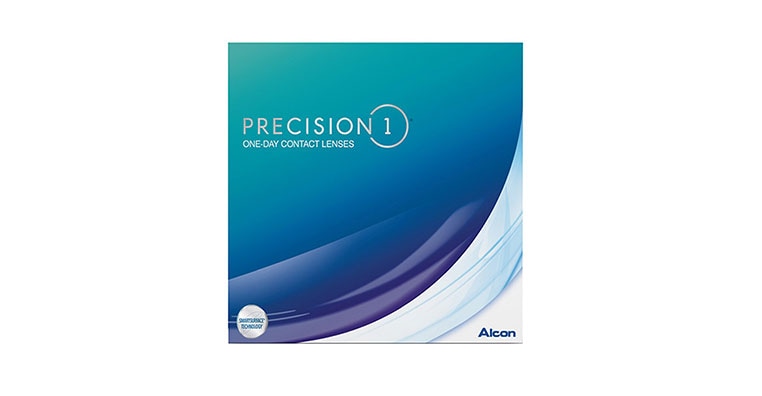
Bring up PRECISION1 if you want a straightforward daily lens that supports comfort with minimal routine steps.
5. Biotrue ONEday
This daily lens is designed with a hydration-focused feel that may help teens who notice dryness in air-conditioned classrooms or during long reading and homework blocks. Starting fresh each day can also reduce buildup that can make lenses feel less comfortable as the day goes on. It provides myopia vision correction, but it does not slow myopia progression unless your child is fitted into a specific myopia-control program recommended by an eye doctor.
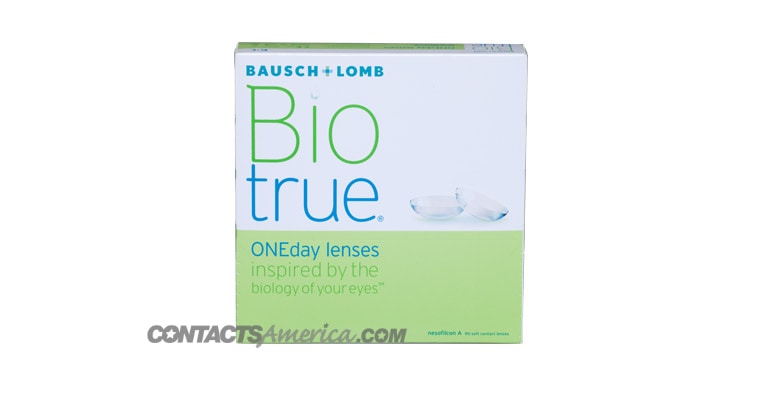
Ask about Biotrue ONEday if your teen wants a daily lens option that prioritizes a hydrated, comfortable feel.
If you are still deciding between schedules for your child, this daily vs monthly contacts guide can help you compare routine, cleaning needs, and convenience.
Quick Comparison Table
| Product | Best For | Notes |
|---|---|---|
| ACUVUE OASYS MAX 1-Day | Screen-heavy days + active routines | Single-use only; no sleeping in lenses |
| ACUVUE OASYS 1-Day with HydraLuxe | Long wear days + simple routine | Keep glasses backup for flare-up days |
| DAILIES TOTAL1 | Comfort-focused daily wear | Replace immediately if damaged/irritating |
| PRECISION1 | Busy schedules + easy handling | Hygiene and hand-drying matter for clarity |
| Biotrue ONEday | Everyday comfort + indoor dryness | Persistent issues = refit, not guess-swaps |
If you’re wondering when a child is typically ready, this answers what age a child can start wearing contact lenses and what factors matter most.
Takeaway for Parents of Children With Myopia
Dim light is not the only factor behind myopia, but your day-to-day setup still matters more than most parents realize. A parent-friendly plan is to keep reading and homework areas well-lit, break up long periods of work, and help your child spend more time outdoors in brighter light, especially if myopia runs in the family.
Ready to plan ahead for clear vision as your child grows? Browse our contact lens collection and everyday vision options to discuss at your child’s next eye exam.
FAQs about Dim Light and Child Myopia
1. Does dim light cause myopia in children?
Dim light by itself is unlikely to be the only cause of child myopia, but consistently doing close work in low light can add strain and may contribute for some kids. The bigger risk pattern is usually a mix of heavy near work and not enough time spent outdoors in brighter light.
2. Does reading in the dark worsen myopia?
A one-time “reading in the dark” moment is not usually the issue. The bigger concern is long, sustained near work, especially when lighting is dim and kids lean in close for long stretches.
3. Do nightlights cause nearsightedness?
A small nightlight is not a proven single cause of nearsightedness. If you use one, keep it low and indirect for sleep comfort, and focus your effort on daytime habits like outdoor time and healthy near-work routines.
4. Are screens the main cause, or is it total near work?
Screens matter, but it is more accurate to think in terms of total close-up time, including screens, books, tablets, and homework. When near work adds up without breaks, it can increase the risk of developing myopia, especially in school aged children.
5. How much outdoor time helps?
Many eye-care groups commonly talk about aiming for around two hours a day outdoors when possible, spread across recess, after school, and weekends. More outdoor time in brighter light is consistently linked with lower myopia risk, even though it cannot guarantee prevention for every child.
6. What lighting is best for homework?
Use a well-lit setup that combines room lighting with a task light so the page or desk is evenly bright without harsh glare. A simple parent rule is this: if your child keeps leaning in or moving the book closer to see clearly, brighten the space and reset posture and distance.
7. What are early signs myopia is worsening?
Common symptoms of myopia changes include squinting at distance, sitting closer to the TV, moving closer to the board at school, headaches after school, and more complaints about blurry distance vision. If you notice patterns getting more frequent, it is a good time to schedule a regular eye exam.
8. When should I book an eye exam?
Book soon if your child shows new distance blur, squinting, frequent headaches, or school complaints about seeing the board. Even without obvious symptoms, kids with a strong family history may benefit from routine checkups because myopia in childhood can progress quietly.
9. What myopia-control options can slow progression?
Depending on your child’s age and prescription, your eye doctor may discuss low-dose atropine drops, myopia-control contact lenses such as MiSight, orthokeratology (Ortho-K), or myopia-control glasses strategies. These are provider-guided options, and your doctor will monitor progression of myopia over time.
10. Can contact lenses help children with myopia? (and when)
Yes, contact lenses for myopia can be an option for older kids or teens when they can follow safe hygiene and your eye doctor approves. Standard lenses correct vision, while myopia-control lenses require specific designs and fitting, so your doctor will confirm what is appropriate for your child’s eyes and routine.
Disclaimer: This content is for general informational purposes only and is not a substitute for professional advice, diagnosis, or treatment.
References
Myopia Control in Children. American Academy of Ophthalmology. https://www.aao.org/eye-health/diseases/myopia-control-in-children. Date Accessed: April 30, 2026.
IMI Risk Factors for Myopia. Ian G. Morgan et al. (International Myopia Institute / Investigative Ophthalmology & Visual Science). https://pubmed.ncbi.nlm.nih.gov/33909035/. Date Accessed: April 30, 2026.
IMI 2021 Reports and Digest – Reflections on the Implications for Clinical Practice. James S. Wolffsohn et al. (International Myopia Institute / Investigative Ophthalmology & Visual Science). https://research.aston.ac.uk/en/publications/imi-2021-reports-and-digest-reflections-on-the-implications-for-c/. Date Accessed: April 30, 2026.
Time Outdoors in Reducing Myopia: A School-Based Cluster Randomized Trial with Objective Monitoring of Outdoor Time and Light Intensity. X. He et al. (Ophthalmology / PubMed). https://pubmed.ncbi.nlm.nih.gov/35779695/. Date Accessed: April 30, 2026.
Effect of Classroom Illuminance on the Development and Progression of Myopia in School Children. Young-Woo Suh et al. (Korean Journal of Ophthalmology / PubMed). https://pubmed.ncbi.nlm.nih.gov/35067020/. Date Accessed: April 30, 2026.
Light Intensity in Nursery Schools: A Possible Factor in Refractive Development. Yuval Cohen et al. (Asia-Pacific Journal of Ophthalmology / PubMed). https://pubmed.ncbi.nlm.nih.gov/35030135/. Date Accessed: April 30, 2026.
Association of Outdoor Artificial Light at Night with Myopia Among Chinese Adolescents: A Representative Cross-Sectional Study. Ting Liu et al. (Frontiers in Medicine). https://www.frontiersin.org/journals/medicine/articles/10.3389/fmed.2024.1469422/full. September 27, 2024.
Light exposure profiles differ between myopes and non-myopes outside school hours. R. Dhakal et al. (BMJ Open Ophthalmology / PubMed). https://pubmed.ncbi.nlm.nih.gov/38816010/. Date Accessed: April 30, 2026.
Myopia and Near Work: A Systematic Review and Meta-Analysis. Frédéric Dutheil et al. (International Journal of Environmental Research and Public Health / PubMed). https://pubmed.ncbi.nlm.nih.gov/36613196/. Date Accessed: April 30, 2026.
Digital Screen Time and Myopia: A Systematic Review and Dose-Response Meta-Analysis. Ahnul Ha et al. (JAMA Network Open). https://jamanetwork.com/journals/jamanetworkopen/fullarticle/2830598.Date Accessed: April 30, 2026.
Related Articles
-
How Coastal Humidity Affects Contact Lens Comfort
-
What Contact Lens Mistakes Seem Harmless but Can Hurt Your Eyes?
-
Eyeing the Options: Focus Dailies or Dailies Aquacomfort Plus?
-

When Were Contact Lenses Invented? A History of the Earliest Contacts
-
Best Contact Lenses for Keratoconus (How to Choose the Right Fit)