
Keratoconus is a cornea shape change (a type of corneal ectasia) that can create irregular cornea optics and “irregular astigmatism,” so a standard soft lens that works great for a regular cornea may still leave you with unstable clarity.
That’s why “best” is rarely one perfect brand. The best contacts for keratoconus are those that match your corneal shape, your vision goals, and your comfort, and that usually takes a few tries with a keratoconus contact lens specialist who fits specialty designs every day.
What Contact Lenses Are Best for Keratoconus?
Mild / Early Keratoconus
Sometimes soft toric lenses or custom soft lenses can work when the cornea is still fairly regular, and you’re mainly correcting lower levels of blur and astigmatism.
Moderate Keratoconus
Many people discuss corneal gas permeable lenses (corneal GP, also called RGP lenses) for sharper optics, or hybrid lenses for keratoconus when you want a mix of crisp vision and more “soft-lens-like” comfort.
More Advanced / Highly Irregular Corneas
Scleral lenses for keratoconus are often the go-to conversation because they vault over the cornea and rest on the sclera, which can create a very stable, centered visual experience for irregular corneas.
If you’re already thinking, “Why do my lenses blur, shift, or feel inconsistent?” that often points to fit, rotation/centration, or surface dryness issues rather than “needing a stronger prescription.” That’s exactly what a specialist fitting and follow-up visits are designed to fine-tune.
If you’re new to rigid lenses, this primer on RGP (gas permeable) contact lenses helps you understand what they feel like and why they can sharpen irregular vision.
Why Regular Soft Contacts Often Don’t Work Well for Keratoconus
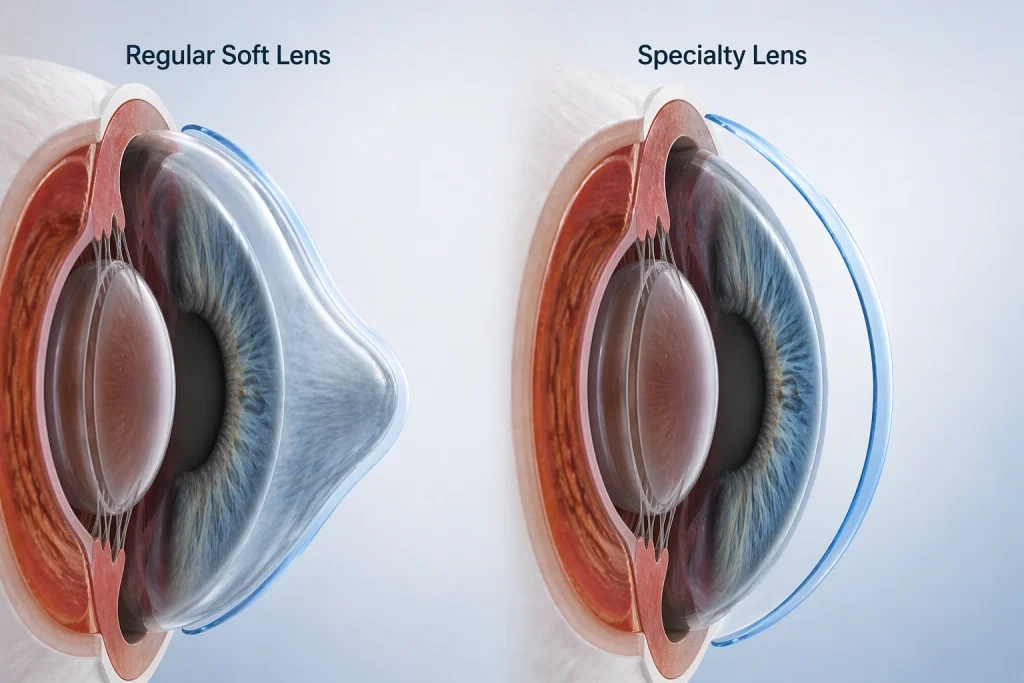
With keratoconus, the cornea gradually becomes more cone-shaped rather than smoothly curved, creating irregular astigmatism. A standard soft lens can “drape” over that uneven shape, so it may not fully smooth out the optics as you need. That’s why keratoconus contacts can look wavy, smeared, or slightly doubled (“ghosting”), and why the blur can change after blinking or as your eyes dry out.
If you’ve ever felt like your vision is sharp for a second and then slips, that’s a common keratoconus pattern. The tear layer and the lens can shift microscopically with each blink, and your focus can change with it. This is also why people searching for irregular cornea contacts often end up discussing specialty designs instead of “regular” soft lenses.
Why Fit Matters More Than Brand
With keratoconus, the brand name usually matters less than whether the lens design matches your cornea shape and how stable it stays on your eye. You can have a prescription that is “close,” but still get blur if the lens centers poorly, rotates, or rides too high or too low. That’s also why many people who try to solve blur by “switching brands” don’t get relief until they see a keratoconus contact lens specialist who can evaluate lens movement, alignment, and the quality of their vision beyond the basic prescription.
The goal is not only comfort, but stable optics. A specialty fit aims to reduce the “vision fluctuation” you notice during the day, especially when lighting changes, your eyes get tired, or your tear film breaks up.
Keratoconus Lens: Pros, Cons, and Who They Fit
Soft Toric Lenses
Soft toric lenses can be a reasonable starting point for mild keratoconus when the cornea is still fairly regular, and most of the blur is from “standard” astigmatism. They can feel familiar, be easy to handle, and sometimes give adequate clarity early on.
- Best for early keratoconus or more regular astigmatism patterns; people who want a simple daily routine while monitoring changes
- Trade-offs may not fully correct true irregular astigmatism as keratoconus progresses; vision can still fluctuate, especially later in the day.
If soft torics keep leaving you with ghosting or “not quite crisp” vision, that’s often the sign you’ve outgrown what a standard soft design can do.
Custom Soft Lenses for Keratoconus
Custom soft lenses are designed specifically for irregular corneas, offering greater stability than standard soft lenses while maintaining a soft-lens feel. They’re often part of the conversation when you want better vision than regular soft lenses, but you’re not ready for (or not tolerating) rigid designs.
- Best for comfort-first wearers who need more stability than standard soft lenses; mild-to-moderate irregularity
- Trade-offs may not reach the “sharpest possible” optics in more irregular cases compared with rigid options
These can be a good middle step when you want improved stability without jumping straight to rigid lenses.
Corneal RGP Lenses for Keratoconus
Corneal RGP lenses (also referred to as RGP lenses or gas-permeable lenses) are commonly discussed because they create a smooth optical surface over an irregular cornea. That smoother front surface is often what improves clarity when soft lenses can’t.
- Best for sharper optics in mild-to-moderate keratoconus; people whose main complaint is distorted vision rather than comfort
- Trade-offs include adaptation time (they feel “present” at first), possible lens decentering on steeper cones, and a higher chance of awareness in wind or dry air.
If your vision is crisp but the lens feels uncomfortable, that’s where your fitter may adjust the design, material, or consider a cushioning strategy like Piggybacking.
Hybrid Contact Lenses for Keratoconus
Hybrid contacts combine a rigid center (for clearer optics) with a soft outer skirt (for comfort and stability). They’re often considered when you want RGP-like clarity but struggle with the feel of a corneal RGP lens.
- Best for people who want RGP-like clarity with more comfort; mild-to-moderate keratoconus where centration and stability can be achieved
- Trade-offs can be more finicky to fit, may not suit every cornea shape, and can be more sensitive to deposits or care routine.
Hybrids can be a strong option when the “clarity vs comfort” trade-off feels too extreme with rigid-only designs.
Scleral Contact Lenses for Keratoconus
Scleral lenses (and scleral contacts) vault over the cornea and rest on the white part of the eye (the sclera). Because they don’t sit directly on the irregular corneal surface, they’re often discussed for higher stability and consistent optics, especially in more irregular cases. Many people also ask about keratoconus contacts for dry eyes because the fluid reservoir can feel more comfortable for some wearers.
- Best for more advanced keratoconus, highly irregular corneas, unstable vision with other lenses, and many cases where centration is hard to achieve
- Trade-offs include higher upfront costs, more involved insertion and removal, and the need for a skilled scleral lens-fitting process for keratoconus with follow-ups.
Scleral designs often become part of the serious discussion because stability is the main win if your biggest frustration is “my vision changes constantly”.
If dryness is a big part of your lens struggle, this explains whether contact lenses can cause dry eyes and what to do if so before you assume it’s only the prescription.
Piggyback System (soft lens + RGP)
Piggyback contacts use a soft lens underneath a corneal RGP lens. The soft lens acts like a cushion, while the RGP lens provides a smoother optical surface for clearer vision. This approach is often considered when you love the clarity of an RGP lens but need help with comfort.
- Best for people who need RGP optics but want extra cushioning; wearers who get irritation from direct RGP-on-eye feel
- Trade-offs include a two-lens routine (more steps, more variables), higher supply requirements, and a care plan that must be consistent.
Piggybacking can be a practical “best of both worlds” setup when your eyes want the RGP clarity but not the RGP sensation all day.
Because piggybacking adds steps, it helps to tighten up technique with cleaning contact lenses properly (tips and mistakes) so buildup doesn’t become your main issue.
How to Choose the Right Fit for Keratoconus
Keratoconus lens fitting is less about picking the “best brand” and more about matching the lens design to your cornea shape and how your eyes behave day to day. A good fitter is basically building a quick profile of your eyes and your routine so they can choose the lens type that has the best chance of staying clear, stable, and wearable.
| Factor | What Fitter Looks At | What To Bring Or Share |
|---|---|---|
| Cornea shape | Cone location, severity, how uneven the surface is, and whether the cone is centered or off-center | Any past corneal topography or tomography results, plus what your doctor told you about severity |
| Eye surface comfort | Dry eye patterns, allergy flareups, and how quickly your tear layer breaks up | When discomfort shows up (right away vs late day), plus triggers like air conditioning (AC), wind, or heating |
| Vision stability | Whether vision changes with blinking, shifts through the day, or looks doubled/ghosted | Specific examples: “Night driving is worst,” “Screens make it worse,” or “It changes every time I blink” |
| Lifestyle and wear time | Long workdays, sports/outdoor time, dusty environments, and how many hours you need lenses | Your typical wear schedule on weekdays and weekends (be honest about your longest days) |
| Handling and upkeep | Insertion/removal comfort, cleaning tolerance, and how much maintenance you can realistically do | What you can commit to consistently, plus any past issues like fogging, irritation, or repeated blur |
Seasonal dryness can make fogging and discomfort worse, so these winter dry-eye contact picks and comfort tips are handy if your eyes flare in colder or drier air.
What to Expect at a Keratoconus Contact Lens Fitting
A keratoconus fitting usually takes longer than a standard contact lens visit, and that’s normal. You’re not just “getting a prescription,” you’re matching a lens design to an irregular cornea so vision stays stable and comfortable in real life. Many appointments include in-office trial lenses so your fitter can see how a lens centers, moves, and performs before you ever leave the clinic.
Measurements Your Fitter Relies On
Your fitter typically uses corneal topography or tomography to map your cornea, refraction to confirm your best vision correction, and ocular surface checks to spot dryness or irritation that can affect comfort and clarity.
If the numbers on your boxes feel confusing, this contact lens prescription glossary helps you decode the terms before your next fitting visit.
How the Fitting Process Usually Unfolds
Most fittings start with a lens category that matches your cornea shape and severity. The fitter prioritizes centering and stability, and finally, you “test” the lenses in real life so adjustments can be based on how they perform after hours of wear.
What to Track During Your Trial Period
During your trial, note when blur shows up, what seems to trigger it, what improves it, any discomfort clues (like scratchiness, pressure, redness, light sensitivity, or fogging), and whether one eye behaves differently from the other.
If you’re ever unsure what counts as a “stop wearing lenses” symptom, this list of warning signs in contact lens use is a good quick reference.
How to Find the Right Clinic
Look for a clinic that clearly fits keratoconus and irregular corneas (especially scleral, RGP, hybrid, or custom soft lenses), ask which lens types they fit most often, confirm they use corneal topography or tomography, and clarify what follow-ups are included since multiple visits are normal.
One small thing that makes a big difference is case hygiene, so here’s a quick how-to on how to clean your contact case the right way.
5 Best Contact Lenses for Keratoconus
Many keratoconus wearers need specialty designs, such as scleral lenses, hybrid contacts, or RGP lenses, for the sharpest, most stable vision. The picks below are meant for mild or early cases, or for backup “soft lens days” when your prescriber says a soft option is safe and realistic for your cornea.
1. DAILIES TOTAL1
- A daily disposable option that can be a helpful discussion point if you want a fresh lens each day and fewer cleaning variables.
- Often considered for comfort-focused wear when your eyes feel reactive, and you want a simple routine.
- Best used as a “soft option” conversation for early cases or backup days, not as a replacement for specialty contact lenses when irregularity is significant.
2. ACUVUE OASYS 1-Day with HydraLuxe
- A daily lens many wearers discuss when long days, screen time, or dry indoor air make lenses feel “present” faster.
- Worth asking about if your goal is steady comfort with a daily schedule and minimal maintenance.
- If blur keeps returning, your fitter can help confirm whether the issue is dryness, fit, or the need for a more specialized design.
3. PRECISION1

- A daily option that’s often chosen when you want straightforward handling and a predictable routine.
- It can be a practical “try and track” lens for early keratoconus discussions, especially if your cornea is still fairly regular.
- If vision fluctuates a lot, that’s a sign to revisit fit and stability rather than forcing wear time.
4. ACUVUE OASYS for ASTIGMATISM
- A toric lens designed for astigmatism, which may be relevant when your doctor says your astigmatism pattern is still regular enough for soft toric correction.
- If you notice on-and-off blur, it may be due to lens rotation or instability, which your fitter can evaluate and adjust.
- This is a common “soft toric” discussion starter, but many keratoconus patients still need irregular cornea contacts, such as RGP or scleral lenses, for crisp vision.
5. Biofinity
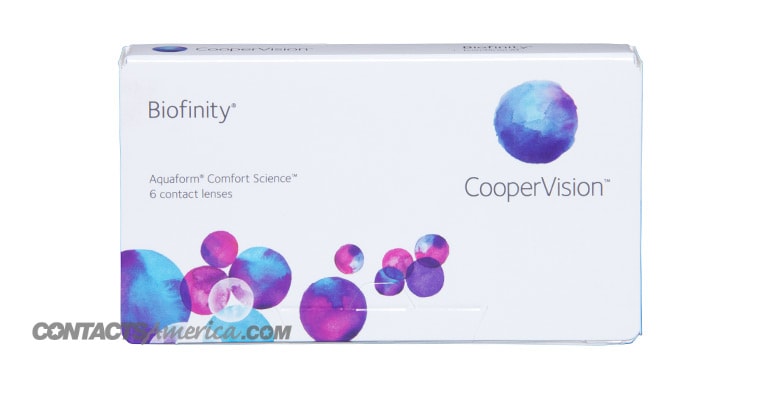
- A monthly lens that can make sense if you do well with reusable routines and your doctor feels a soft monthly option is appropriate.
- Works best when you are consistent with cleaning, replacement timing, and comfort monitoring.
- If deposits or dryness build through the month, that feedback helps your fitter decide whether a daily schedule or a specialty design would be a better match.
Comparison Table
| Product | Wear Schedule | Best For | Notes |
|---|---|---|---|
| DAILIES TOTAL1 | Daily Disposable | Simple routine, comfort-first daily wear | Usually a backup/early-case option; not for significant irregularity |
| ACUVUE OASYS 1-Day with HydraLuxe | Daily Disposable | Long routines, screen-heavy days | Discuss if comfort drops late day; fit still matters |
| PRECISION1 | Daily Disposable | Straightforward handling and routine | Useful “trial and track” lens when cornea is still fairly regular |
| ACUVUE OASYS for ASTIGMATISM | 2-Week Toric | Regular astigmatism patterns | Rotation/stability can drive blur; many KC cases still need specialty lenses |
| Biofinity | Monthly | Reusable routine wearers | Needs consistent care; deposits/dryness may signal daily or specialty change |
Choosing Keratoconus Contacts Comes Down to Fit, Not Hype
The best keratoconus lenses are the ones that match your cornea shape, your severity level, and what you actually need day to day, like driving clarity, screen comfort, or long wear time. Most people get the best results by working with a specialist fitter, following a short trial-and-compare plan, and tracking how changes in their vision and comfort affect them throughout the day. Once you know what your eyes tolerate best, the “right” choice feels less like guessing and more like dialing in a system that works.
Want options to discuss at your fitting? Browse our contact lenses, then confirm with your prescriber what’s safe and effective for your cornea.
FAQs about Contact Lenses for Keratoconus
1. What contact lenses are best for keratoconus?
The best contacts for keratoconus are those that match your corneal shape and keep your vision stable, not just the strongest prescription. Mild cases may do fine with soft toric or custom soft lenses. Still, many moderate-to-advanced cases see more consistent clarity with RGP lenses, hybrid contacts, or scleral lenses fitted by a specialist.
2. Are scleral contacts for keratoconus worth it?
For many people, scleral lenses for keratoconus are worth it because they vault over the irregular cornea for steadier vision and can feel comfortable since they rest on the white of the eye. The trade-offs are higher cost, more customization, and a more involved fitting and care routine.
3. Are RGP lenses for keratoconus better than soft lenses?
Often, yes. RGP lenses for keratoconus can provide sharper, more stable vision than standard soft lenses because their rigid surfaces help neutralize irregular optics. The downside is a longer adaptation period and possible decentering on steeper cones, so fit quality matters a lot.
4. Are hybrid contact lenses for keratoconus comfortable?
Hybrid lenses pair a rigid center for clearer optics with a soft skirt for comfort and stability, making them a good middle ground for some wearers. Comfort is usually good when the fit is dialed in, but hybrids can be finicky to fit and aren’t ideal for every cone shape.
5. Can I wear normal soft contacts if I have mild keratoconus?
Sometimes. Early keratoconus with a relatively regular cornea may still work with soft toric lenses or custom soft keratoconus designs. If vision gets smeary, ghosted, or fluctuates during the day, that’s often a sign you need a different lens design or fit adjustment rather than a stronger prescription.
6. What should I do if my keratoconus lenses feel foggy or blurry?
Start with the common causes such as dryness, deposits, or a lens that’s shifting, and use lens-compatible drops only if your fitter approves them. If fogging or blurring keeps returning, schedule a fit check so the clinic can adjust the design or care plan, rather than guessing at home.
7. How often do keratoconus lenses need to be replaced?
It depends on the lens type and your fitter’s plan, since specialty lenses are customized and may have different replacement schedules than standard soft lenses. Replace earlier if you notice persistent deposits, surface wear, cracks/chips, or declining clarity that doesn’t improve after proper cleaning.
8. Do scleral lenses help with dry eyes in keratoconus?
They can help some people because scleral vaults the cornea and can maintain a more stable fluid environment in front of it. Results still depend on fit, wear time, and handling, so tell your fitter if dryness is a major issue, so it’s built into your lens plan.
Disclaimer: This content is for general informational purposes only and is not a substitute for professional advice, diagnosis, or treatment.
References
Keratoconus (StatPearls). George Asimellis; Evan J. Kaufman / StatPearls Publishing (National Center for Biotechnology Information Bookshelf, National Library of Medicine). https://www.ncbi.nlm.nih.gov/books/NBK470435/. Date Accessed: April 23, 2026.
Keratoconus. EyeWiki (American Academy of Ophthalmology). https://eyewiki.org/Keratoconus. Date Accessed: April 23, 2026.
Keratoconus Diagnosis and Treatment: Recent Advances and Future Directions. Andrew D. Bui et al. (Clinical Ophthalmology). https://pmc.ncbi.nlm.nih.gov/articles/PMC10511017/. September 16, 2023.
Contact Lens Prescribing Trends for Keratoconus at an Academic Medical Center: Increased Utilization of Scleral Lenses for Severe Disease. Angelica C. Scanzera et al. (Eye & Contact Lens). https://journals.lww.com/claojournal/abstract/2022/02000/contact_lens_prescribing_trends_for_keratoconus_at.2.aspx. Date Accessed: April 23, 2026.
Quality of life and vision assessment with scleral lenses in keratoconus. Shivanand R. Hadimani et al. (Saudi Journal of Ophthalmology). https://pmc.ncbi.nlm.nih.gov/articles/PMC11232749/. Date Accessed: April 23, 2026.
Comparison of Hybrid Contact Lenses and Rigid Gas-Permeable Contact Lenses in Moderate and Advanced Keratoconus. Yelda Yıldız Taşcı et al. (Turkish Journal of Ophthalmology). https://doi.org/10.4274/tjo.galenos.2022.82754. Date Accessed: April 23, 2026.
Effects of a new-generation hybrid contact lens on visual performance and vision-related quality of life in patients with keratoconus. Sait Coşkun Özcan; Deniz Özarslan Özcan (Arquivos Brasileiros de Oftalmologia). https://doi.org/10.5935/0004-2749.20230001. Date Accessed: April 23, 2026.
Clinical Outcome of Hybrid Contact Lenses in Keratoconus. Dave Kloeck et al. (Eye & Contact Lens). https://doi.org/10.1097/ICL.0000000000000738. Date Accessed: April 23, 2026.
Efficacy of custom-made soft keratoconus lenses on corneal aberrations and photic phenomena in patients with keratoconus: a corneal topography imaging based study. Ayşegül Penbe et al. (International Journal of Ophthalmology). https://pmc.ncbi.nlm.nih.gov/articles/PMC9815985/. Date Accessed: April 23, 2026.
Application of piggy-back lens in the correction of severe keratoconus: A case study. Fang-Fang Lan et al. (Technology and Health Care). https://journals.sagepub.com/doi/abs/10.3233/THC-212889. Date Accessed: April 23, 2026.
Related Articles
-
1-Day Acuvue Moist vs. Dailies Aquacomfort Plus: Which Reigns Supreme?
-

‘Eye Love You’: 5 Best Contact Lenses for Your Beloved This Valentine’s Day
-
On Eco-Friendly Contact Lenses: ACUVUE Oasys 1-Day vs Biotrue ONEday
-

What Are the Warning Signs to Watch for in Contact Lens Use?
-

US Truck Drivers’ Guide to the Best Contact Lenses for Night Driving