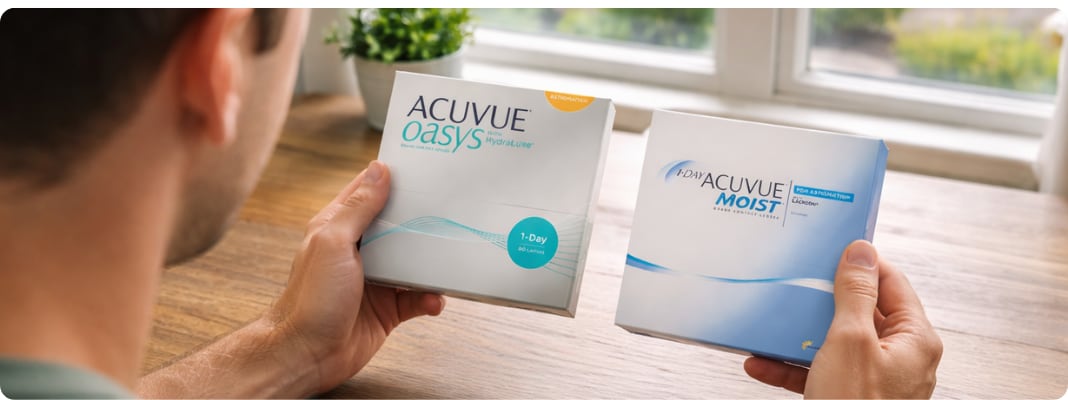
Trying to decide between Acuvue Oasys 1-Day vs 1-Day Acuvue Moist for Astigmatism because your eyes feel different from one day to the next? You are not imagining it. With astigmatism, you need toric lenses that stay stable on the eye, and comfort can change fast depending on the material, fit, and even where you spend your day.
Here is the simple way to choose between these two popular daily disposable contacts for astigmatism, plus the comfort differences people notice in real life, like long screen days, air conditioning or heating, and dry indoor air.
Which One Should You Choose?
Both are daily toric lenses designed to correct astigmatism by staying in the right orientation for clear vision. The “best” option is the one that fits your eyes well and still feels good after a few hours, so use this as a decision shortcut, then confirm with your eye doctor.
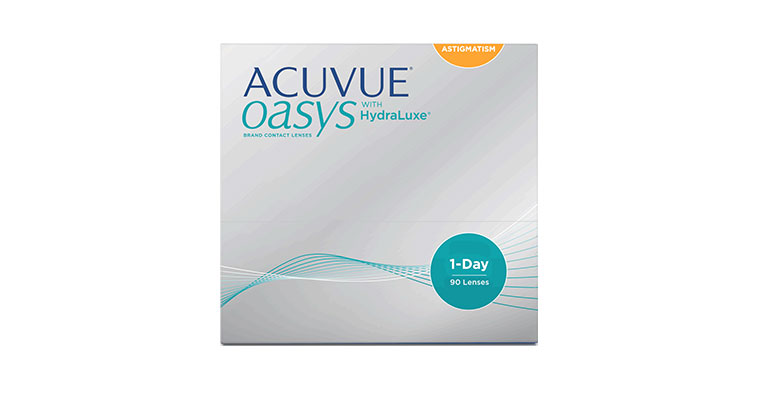

Choose ACUVUE OASYS 1-Day for Astigmatism If You Want
- A more breathable, long day feel from silicone hydrogel, especially if your eyes feel tired after hours of wear
- Better day to night comfort when you are around air conditioning or heating, windy commutes, or other drying environments
- A lens built around HydraLuxe comfort technology, which is designed to support a smoother, more consistent tear film feel for many wearers
Choose 1-Day ACUVUE Moist for Astigmatism If You Want
- A softer hydrogel lens feel, especially if you prefer a gentler “first on” sensation
- Moisture focused comfort through LACREON technology, which is designed to help the lens stay comfortable by retaining a wetting component in the lens
- A reliable daily toric option that many wearers find comfortable for regular routines, especially when their eyes are not pushed by extra dry conditions
Reality Check: If either lens feels dry, blurry, or “twisty,” it can be a fit or stability issue, not just the brand. Your prescription details like CYL and AXIS, your eye shape, and how your lids interact with the lens all affect comfort, so a quick refit can make a bigger difference than switching on your own.
Side by Side Comparison
If you are deciding between Acuvue Oasys 1-Day for Astigmatism and 1-Day Acuvue Moist for Astigmatism, this snapshot is the fastest way to see what is actually different. Both are daily disposable toric contact lenses designed to keep the lens aligned for clearer vision with astigmatism, but they can feel different depending on your eyes and your day.
| Feature | Acuvue Oasys 1-Day for Astigmatism | 1-Day Acuvue Moist for Astigmatism |
|---|---|---|
| Lens Type + Schedule | Daily disposable (single day wear) | Daily disposable (single day wear) |
| Material | Silicone hydrogel (senofilcon A) | Hydrogel (etafilcon A) |
| Comfort Tech | HydraLuxe Technology | LACREON Technology |
| Astigmatism Stability Design | BLINK STABILIZED Design | BLINK STABILIZED Design |
| UV Blocking | Yes (built in UV blocking; level varies by lens) | Yes (built in UV blocking; level varies by lens) |
| Parameters (Sphere, Cyl, Axis) | Available ranges vary by prescription | Available ranges vary by prescription |
Note on Parameters: Toric availability can differ by power, cylinder, and axis combination, so the “right” option is often the one that matches your exact prescription and fits well on your eye.
Features that Matter for Comfort and Clear Vision
Material and breathability
The biggest “feel” difference often starts with material: silicone hydrogel lenses generally allow more oxygen through the lens than traditional hydrogel, which some wearers find more comfortable on longer days. That said, dryness and irritation are not only about oxygen, since tear film quality, blinking, screen time, and room airflow matter too. If you are choosing based on comfort alone, it helps to think of material as one factor, not a guarantee.
Moisture and Comfort Technology
HydraLuxe is positioned as a “tear inspired” design that aims to mimic natural tear properties for comfort and performance, which can appeal if your eyes feel stressed by long days or lots of screen use.
LACREON is positioned as a moisture cushion approach, and the ACUVUE Moist family highlights long lasting moisture comfort (not everyone experiences it the same way, but that is the design goal).
Practical takeaway: if you tend to like a “silky, stable” lens feel, you may lean toward Acuvue Oasys 1-Day for Astigmatism; if you prefer a “soft hydrogel” feel and do well with moisture focused designs, 1-Day Acuvue Moist for Astigmatism may feel better on your eye.
Astigmatism Stability and Rotation Control
“With astigmatism” lenses are toric contact lenses, which means they must stay aligned at the right axis to keep vision crisp. When a toric lens rotates, you can notice blur, smearing, or fluctuating clarity, especially on screens, in bright lighting, or when you are tired. Both lenses use a stabilization design (listed as BLINK STABILIZED Design) intended to help keep the lens oriented more consistently during blinking.
If you want a quick refresher before choosing, this guide explains what toric lenses are and how they work in plain terms.
UV Protection, What It Helps With and What It Does Not Replace
Both options include built in UV blocking, but it is important to treat that as “extra protection,” not full sun coverage. UV blocking contacts do not cover the whole eye area, so they are not a substitute for sunglasses when you are outdoors.
If UV protection is a top priority for you, confirm the specific UV blocking details for your exact lens with your eye doctor or the product’s official patient information, since details can vary by product variant and market.
Comfort in Real Life: Screens, Dry Air, and Long Days
Even with the “right” toric lens on paper, comfort can change a lot once real life shows up. If you are comparing Acuvue Oasys 1-Day for Astigmatism and 1-Day Acuvue Moist for Astigmatism, it helps to think about your most common days, not your best days.
Screen Time Comfort and Blink Habits
Long stretches of screen time can make contact lenses for astigmatism feel noticeable faster because people blink less and blink less fully when they focus on a screen. That can leave the lens surface drier, which may feel like mild scratchiness, “lens awareness,” or fluctuating clarity.
Habits that usually help without being a big production
- Do a quick blink reset every few minutes, then look across the room for a few seconds
- Follow the 20 20 20 approach as a reminder to pause and blink more normally
- If you use drops, choose contact lens rewetting drops that are labeled safe for contacts, then use them as directed
- If your eyes feel tired, switch to glasses for a while instead of pushing through discomfort
If you are often on screens in dry rooms, many wearers prefer a lens that stays comfortable for long wear time, which is one reason people look at Acuvue Oasys 1-Day for Astigmatism as a “long day” option. Still, some wearers prefer the softer hydrogel feel of 1-Day Acuvue Moist for Astigmatism, especially if their eyes do well with hydrogel materials.
If screen days are your biggest struggle, this digital detox eye health guide has simple habits that pair well with contacts.
Dry Indoor Air, Travel, and Seasonal Triggers
Dry air is a common reason toric lenses feel fine early, then feel off later. Air conditioning and heating can dry the tear film, flights can add low humidity, and wind can irritate the eye surface even if you are not outside for long.
What to Bring On “Dry Air” Days
- Approved eye drops for contacts
- Glasses as a backup plan
- If you wear reusable lenses at times, a travel size contact lens solution and clean case
- A simple reminder to shorten wear time if comfort drops
If you are planning a long day out, travel, or a late night event, your comfort often improves more from a solid backup plan than from forcing lenses to last longer than they want to. This deeper explanation on why your eyes feel dry when the AC or heater is on helps you spot triggers and adjust your routine.
Sensitive Eyes Considerations
If your eyes are sensitive, it is normal for comfort to vary between two good brands. Sensitivity can come from dryness, allergies, eyelid inflammation, or solution reactions, and sometimes the fix is not a different “best lens,” but a better match for your eye surface.
Ask your eye doctor about a change if you notice any of these patterns
- Your eyes feel irritated in the same environments every time, like air conditioning or heating
- You get frequent end of day redness or burning
- One lens feels consistently worse than the other eye
- Comfort is okay, but your vision keeps shifting
Sometimes a different daily toric lens, a small fit adjustment, or a routine tweak is the real upgrade. If you have sensitive eyes, it can also help to understand whether high water content lenses are bad for sensitive eyes and why that can affect comfort.
Fit and Prescription Details that Can Make or Break Comfort
For astigmatism, comfort and clarity are tied together because toric lenses must stay aligned. Use this checklist to spot what matters most, especially if you are choosing between Acuvue Oasys 1-Day vs Acuvue Moist for Astigmatism.
Need a quick cheat sheet for the terms on your prescription? Use this contact lens prescription glossary to decode what each number means.
Prescription Elements that Matter for Toric Lenses
- Sphere
This is your main near or far power. If it is off, you may feel eye strain or persistent blur. - Cylinder
This is the amount of astigmatism correction. If the cylinder is not matched correctly, vision may feel smeared or “shadowed,” especially on screens and at night. - Axis
This is the direction of astigmatism correction. Small axis differences can noticeably change clarity, and the lens must stay aligned to keep that axis working. - Base Curve And Diameter
Your prescription may not always list these for every brand, but they matter for fit. A lens that fits poorly can feel dry, move too much, or feel tight.
Bottom Line: with toric contact lenses, the exact numbers and the way the lens sits on your eye both matter. Two lenses can have the same prescription values and still feel different because they interact differently with your eyelids and tear film.
If you are comparing your glasses paperwork to your contacts, keep in mind that contact lens prescriptions are not the same as glasses prescriptions.
What to Do If Your Vision Fluctuates or Feels Unstable
If your vision goes clear, then blurry, then clear again, it is usually a sign the toric lens is rotating, drying out, or not settling consistently.
Common Reasons This Happens
- Lens rotation or a stability mismatch for your blink pattern
- Dryness that makes the lens “grab” unevenly
- Axis or cylinder that needs refinement
- Fit that is slightly loose or slightly tight
What To Do Next
- Blink a few times and give the lens a moment to center
- If it still fluctuates, remove the lens and check for debris or damage
- Try again with a fresh lens if you wear daily disposable contacts
- If the pattern repeats, book a follow up and ask about a toric refit or axis adjustment
If you are torn between these two options, this is the practical way to decide: pick the lens that gives you the most stable clarity and the least “lens awareness” on your longest, driest, most screen heavy days.
Reviews and Real Wearer Feedback
Real world reviews can be useful, but they are never one size fits all. With toric contact lenses especially, comfort and clarity depend a lot on fit, tear film, and how the lens rotates on your eye.
What People Like vs Common Complaints
| Lens | What People Tend To Like | Common Complaints |
|---|---|---|
| Acuvue Oasys 1-Day for Astigmatism | All day comfort on longer wear days, more stable vision for screen heavy routines, less “lens awareness” once it settles | Dryness late day in very dry rooms, occasional lens awareness if it is slightly tight, inconsistent clarity if the lens rotates |
| 1-Day Acuvue Moist for Astigmatism | Softer feel right away, comfortable daily routine with no cleaning, good everyday performance for many wearers | End of day dryness for some people, blur that comes and goes if the lens does not stay aligned, comfort changes in air conditioning or heating |
Common Complaints for Both and What They Usually Mean
Dryness Late Day
Often points to dry air, reduced blinking, or a lens surface that needs a different material match. It can also mean you may do better with a different daily toric option or a shorter wear time.
Blur that Comes and Goes
This is frequently a rotation or axis issue with astigmatism contact lenses. A small fit change or axis adjustment can make a big difference.
Burning, Tearing, or Gritty Feeling
Sometimes it is dryness, sometimes it is irritation from allergens or a sensitive eye surface. If it happens often, it is worth asking your eye doctor about a dry eye check and a fit review.
Quick Reminder: Reviews are subjective. The best review is how your own eyes feel after a full day, in your real routine.
Price, Value, and Buying Tips
Both are daily toric lenses, so the biggest value question is usually comfort per day and consistency, not just the lowest price.
What Affects Price
- Pack Size
Larger boxes often lower the cost per lens compared to smaller packs. - Promotions and Rebates
Manufacturer rebates, seasonal deals, and retailer promos can change the final cost. - Prescription Range and Availability
Some prescriptions and axis combinations can be easier to source than others, which may affect availability and delivery time. - How Often You Wear Lenses
If you wear lenses most days, your best value is usually the lens that stays comfortable and stable the longest, not the one you tolerate.
How to Buy Safely Online
- Use a current contact lens prescription
In the US, retailers verify prescriptions for safety and accuracy. - Do not swap brands or models without prescriber approval
Even if both are daily toric lenses, the fit and design can differ enough to change comfort and vision. - If your lenses feel wrong, do not “power through”
Switch to glasses and follow up, especially if you get worsening redness, pain, or vision changes.
How to Decide With Your Eye Doctor
If you are stuck between these two, the fastest path is a structured test drive with your eye doctor, not guessing from spec sheets.
The Best Test Drive Approach
Ask about trial lenses for both options and compare them with the same routine. A simple plan is 3 to 7 days per lens so you get past day one learning effects.
Track these four things each day
- Morning comfort in the first 30 minutes
- Stability of vision during screens and driving
- Dryness or irritation at the end of the day
- How often you needed drops or wanted to switch to glasses
If one lens is consistently clearer and more comfortable by late afternoon, that usually answers the question. Start with this first-time contact lens user guide before you compare brands if you are newer to contacts and want the basics in one place.
When Switching Is A Bad Idea Without Guidance
Do not switch brands on your own if you have any of these
- Ongoing redness that does not settle
- Sharp pain or strong burning
- Light sensitivity
- Discharge
- Vision changes that do not clear after removing the lens
Those are signs to stop lens wear, switch to glasses, and get advice from an eye doctor before trying another lens.
If you are choosing between ACUVUE OASYS 1 Day for Astigmatism and 1 Day ACUVUE Moist for Astigmatism, the best decision is the one that stays comfortable and clear in your real day, not just on paper. Both are solid daily toric contact lenses, but your eyes may prefer one material over the other depending on screen time, dry indoor air, and how stable the lens sits on your eye. If you notice end of day dryness, fluctuating blur, or irritation, a quick fit check and trial comparison with your eye doctor can usually solve it faster than guessing.
Which daily toric feels best on your eyes and stays clear the longest in your routine? Shop 1-Day Acuvue Moist for Astigmatism or Acuvue Oasys 1-Day for Astigmatism and order the option that fits your comfort needs and prescription.
ACUVUE OASYS 1-Day vs ACUVUE Moist for Astigmatism FAQs
1. What is the main difference between ACUVUE OASYS 1-Day and ACUVUE Moist for astigmatism?
Both are daily toric contact lenses made to correct astigmatism, but they use different materials and comfort designs. ACUVUE OASYS 1-Day for Astigmatism is a silicone hydrogel lens built for breathability and long day comfort, while 1-Day ACUVUE Moist for Astigmatism is a hydrogel lens designed for a soft, moisture focused feel. The best pick usually comes down to how your eyes handle dry indoor air, screen time, and long wear days.
2. Which is better for long days and screen time?
Many wearers prefer ACUVUE OASYS 1-Day for Astigmatism for long, screen heavy days because silicone hydrogel lenses tend to feel more breathable over time. That said, some people still do great with 1-Day ACUVUE Moist for Astigmatism if their eyes stay comfortable and the fit is stable. If your lenses feel present faster on screens, blink breaks and approved rewetting drops can help, but a fit check is still the real solution if it keeps happening.
3. Which one feels more comfortable if my eyes are dry or sensitive?
Comfort is personal, but patterns are common. People who want a softer initial feel often lean toward 1-Day ACUVUE Moist for Astigmatism, while people who notice end of day dryness often do better in a breathable silicone hydrogel option like ACUVUE OASYS 1-Day for Astigmatism. If you have ongoing dryness or irritation, ask your eye doctor about a dry eye evaluation and whether a different daily toric material would be a better match.
4. Why does my vision get blurry sometimes with toric lenses?
With astigmatism lenses, blur usually means the lens is rotating and the correction is no longer lined up. That can happen from dryness, a small fit mismatch, or an axis that needs adjustment. If your vision clears when you blink then goes blurry again, mention it at your follow up because a small change can make your astigmatism contact lenses feel dramatically more stable.
5. Do both lenses have UV protection, and does it replace sunglasses?
Both lines offer UV blocking, but the level varies by model. UV blocking contacts help protect parts of the eye, but they do not cover the entire eye area and do not replace sunglasses. For outdoor time, wear sunglasses or protective eyewear over contacts for better overall coverage.
6. Can I switch between these two lenses whenever I want?
It is best not to swap brands without prescriber approval, even if both are daily toric lenses. Material, fit, and stabilizing design can change how your eyes feel and how clearly you see. If you want to switch, ask your eye doctor for a trial so you can compare comfort and clarity safely.
7. How do I know which one to try first?
Start with your routine. If you want a breathable feel for long days in air conditioning or heating, ACUVUE OASYS 1-Day for Astigmatism is often a strong first trial. If you want a soft, moisture oriented daily lens feel, 1-Day ACUVUE Moist for Astigmatism is a common starting point, especially if your eyes do well with hydrogel lenses.
Disclaimer: This information is for general informational purposes only and is not a substitute for professional advice, diagnosis, or treatment.
References
ACUVUE® OASYS Brand Contact Lenses 1-Day with HydraLuxe® Technology for Astigmatism: Patient Instruction Guide. Johnson & Johnson Vision Care, Inc. https://assets.contentstack.io/v3/assets/blt541542d4b6d9d1cc/bltb8b4f795fd6bf882/av-oasys-1day-pig.pdf. Date Accessed February 17, 2026.
ACUVUE OASYS® 1-Day for ASTIGMATISM: Package Insert (Toric Fitting Guidelines). Johnson & Johnson Vision Care, Inc. https://assets.contentstack.io/v3/assets/blt541542d4b6d9d1cc/blt2899deb8804b8ab5/av-oasys-1day-pi.pdf. Date Accessed February 17, 2026.
1-DAY ACUVUE® MOIST Brand Contact Lenses for ASTIGMATISM: Patient Instruction Guide. Johnson & Johnson Vision Care, Inc. https://assets.contentstack.io/v3/assets/blt541542d4b6d9d1cc/blt16dcad51e5421187/1day-av-moist-pig.pdf. Date Accessed February 17, 2026.
1-DAY ACUVUE® MOIST Brand Contact Lenses for ASTIGMATISM: Package Insert (Toric Fitting Guidelines). Johnson & Johnson Vision Care, Inc. https://assets.contentstack.io/v3/assets/blt541542d4b6d9d1cc/bltdd1e3c955cfdec1b/1day-av-moist-pi.pdf. Date Accessed February 17, 2026.
About Contact Lens Types. Centers for Disease Control and Prevention. https://www.cdc.gov/contact-lenses/about/about-contact-lens-types.html. Date Accessed February 17, 2026.
Related Articles
-

What Happens If You Sleep With Contacts? The Honest Breakdown
-

Corneal Ulcers: Causes, Prevention, and Recovery
-
Daily vs Bi Weekly Contacts (Which Fits Your Routine Better)
-
2026 Super Bowl LX: Contact Lens Comfort and Safety Tips for On Screen and Stadium
-

What Is Presbyopia After 40? Causes, Symptoms, and Contact Lens Options