Stephen Nedoroscik, the “Pommel Horse Guy,” is one of the few athletes who captured the world’s attention at the 2024 Paris Olympics. He has stunned the world with his gymnastic capabilities and was even tagged as the ‘Kent Clark’ in the Olympics.
One of the lesser-known aspects of the vision problems of Stephen Nedoroscik: strabismus and coloboma. These vision impairments, while often overlooked, have undoubtedly shaped his life and athletic career.
Who is Stephen Nedoroscik

At 25 years old, Nedoroscik has gained recognition for his remarkable skills on the pommel horse which requires a balance of strength, rhythm, and precision.
Nedoroscik’s performance helped his team secure a bronze medal—the US’ first in this category since 2008. His success didn’t stop there; he also earned an individual bronze in the pommel horse event, captivating audiences with his 40-second routine.
What makes Nedoroscik’s achievements even more noteworthy is his ability to excel despite significant visual challenges. Competing at an elite level with two distinct eye conditions, he has shown incredible determination and adaptability, inspiring many with his story.
What are Stephen Nedoroscik’s Eye Problems
Stephen Nedoroscik, the American gymnast known for his exceptional performances on the pommel horse, has two distinct eye conditions: strabismus and coloboma.
Strabismus
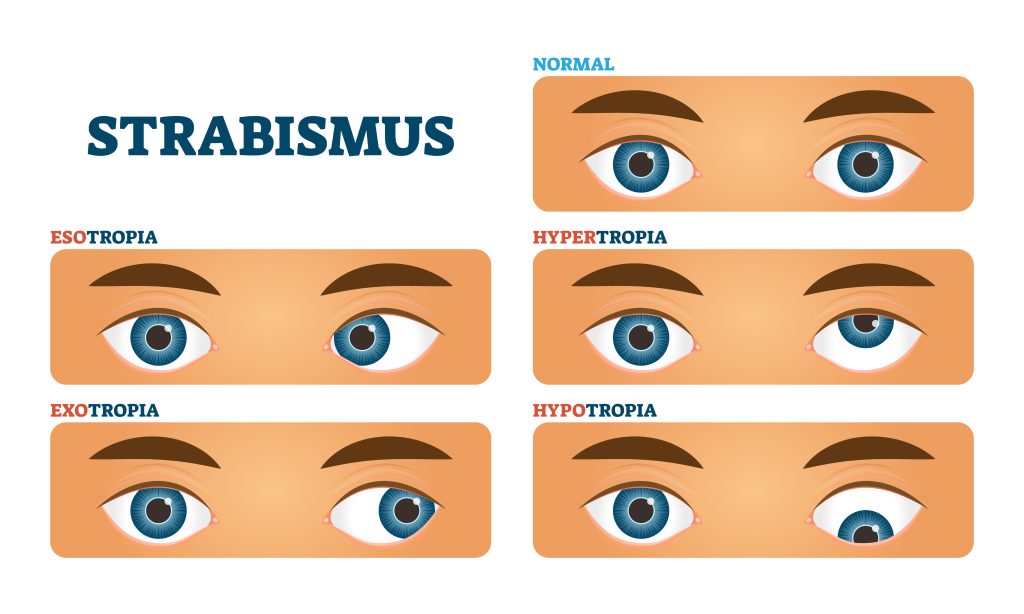
Strabismus, commonly known as “crossed eyes,” is a condition where the eyes do not align properly. Instead of looking at the same point, one eye turns inward, outward, up, or down. This misalignment can be constant or intermittent.
There are several types of strabismus, categorized by the direction in which the eye turns:
| Type | Description |
| Esotropia | Inward turning of the eye (crossed eyes) |
| Exotropia | Outward turning of the eye (wall eyes) |
| Hypertropia | Upward deviation of one eye |
| Hypotropia | Downward deviation of one eye |
Causes of Strabismus
The root cause of strabismus often lies in the muscles that control eye movement. However, other factors can contribute, including:
- Weakness or overactivity of eye muscles.
- Issues with the nerves that control eye movement.
- Problems in the brain’s control center for eye movement.
- Eye conditions like nearsightedness or farsightedness
- Certain health conditions, like thyroid disease or diabetes
- Genetics
Symptoms of Strabismus
The most obvious symptom of strabismus is misaligned eyes.
Other symptoms may include:
- Double vision
- Squinting
- Headaches
- Eye strain
- Difficulty with depth perception
Can Strabismus Be Corrected?
Strabismus can often be treated through non-invasive approaches to surgical interventions.
Corrective lenses like glasses or contact lenses can correct refractive errors that contribute to the misalignment. In some cases, especially in children, eye patching is used to strengthen the weaker eye and improve alignment. Vision therapy, which involves specific eye exercises, is another non-surgical option that enhances eye coordination and focus.
In more severe instances, eye muscle surgery might be necessary to physically adjust the eye muscles and correct alignment. Early detection and treatment are essential, particularly in children, to prevent amblyopia or lazy eye.
Coloboma
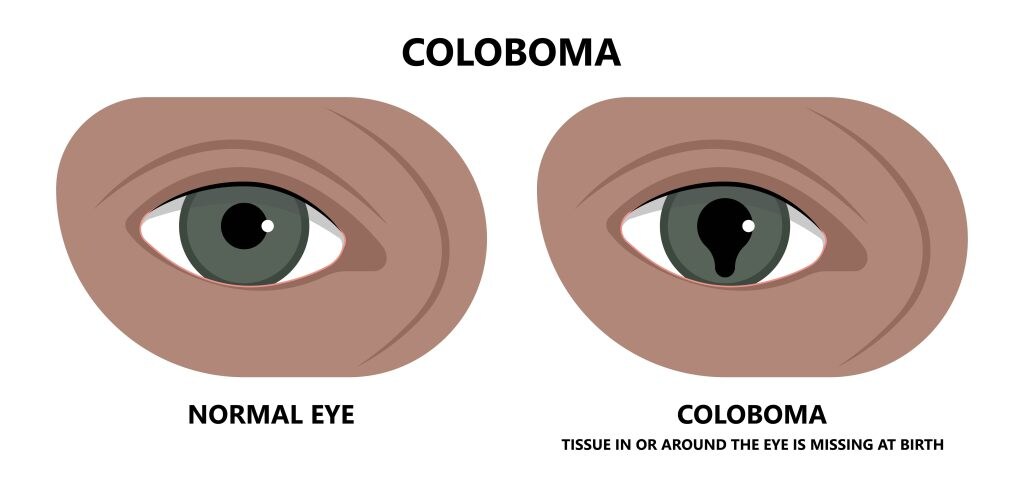
Coloboma is a birth defect characterized by a gap or missing tissue in the eye.
It occurs when the eye fails to develop completely during fetal development. While the exact cause is often unknown, it’s believed to be due to a disruption in the normal closure of a fetal eye structure called the choroidal fissure.
The location of the missing tissue determines the type of coloboma:
| Type | Description |
| Iris coloboma | Keyhole-shaped pupil |
| Choroidal coloboma | Missing tissue beneath the retina, often causing vision problems |
| Retinal coloboma | Involves the retina, affecting light sensitivity |
| Optic nerve coloboma | Gap in the optic nerve, leading to potential vision loss |
| Lens coloboma | Less common type affecting the eye’s lens |
| Eyelid coloboma | Gap in the eyelid |
Causes of Coloboma
Symptoms vary depending on the location and severity of the coloboma. Some individuals with coloboma may have no noticeable symptoms, while others may experience:
- Abnormal pupil shape (keyhole or oval)
- Decreased vision
- Sensitivity to light
- Nystagmus (involuntary eye movement)
- Strabismus (crossed eyes)
Symptoms of Coloboma
The exact cause of coloboma is often unknown, but several factors may increase the risk, including:
- Genetics
- Chromosomal abnormalities (e.g. Down syndrome and trisomy 13)
- Maternal factors
Can Coloboma Be Corrected?
Coloboma currently has no direct cure since the absent tissue cannot be regenerated or replaced. However, various treatments are available to manage the condition. The approach to treatment largely depends on the specific type and severity of the coloboma.
For some individuals, corrective lenses such as glasses or contact lenses can help address refractive errors associated with certain types. In cases of iris coloboma, surgery may be performed to improve the appearance of the iris, while eyelid coloboma might need surgical repair to correct both the appearance and function of the eyelid. For those with vision impairments due to coloboma, low vision aids such as magnifiers or screen readers can help.
Key Takeaway
The Olympic gymnast’s success extends far beyond his medal-winning performances. As an elite athlete with visual challenges, he has become a powerful role model for people facing similar obstacles. To manage Stephen Nedoroscik’s vision problems, he uses eyeglasses which he takes off during performances.
Alternatively, people with similar conditions can use contact lenses instead of eyeglasses. While aren’t a cure-all, they can provide a level of visual correction that allows individuals with strabismus and coloboma to pursue their passions with greater confidence. This can enhance not only daily activities but also performance in sports and other precision-based tasks.
Related Articles
-
Weight Loss Drugs and Eye Stroke Risk (What Research Shows)
-
Best Contacts for Winter Dry Eyes: Top Picks and Comfort Tips
-

Seeing Love Clearly: Unique Valentine’s Day Gifts for Better Eye Health
-
What Happens If You Sleep With Contacts? The Honest Breakdown
-
Contacts or Glasses in Snowy Conditions: What US Wearers Should Know This Winter